Who Would Pay Chicago’s Proposed Head Tax: Probing the Impact of Exemptions
Summary
- Mayor Johnson's proposed head tax is a flat fee per covered worker. If workers ultimately bear its cost through lower wages, that fee takes a larger share of a low-paid worker's income. It also raises the cost of employing a low-wage worker by a larger percentage, creating a potential disincentive to hiring.
- The proposal's exemptions are more likely to exclude low-wage workers than high-wage workers. They narrow the tax's reach and reduce its average impact on employment costs, although covered employers still face the full fee for each covered worker.
- We estimate that 26% of Chicago-resident workers would be subject to the tax—a likely overestimate because of data limitations. About 10% of Chicago households with incomes under $50,000 would include someone subject to the tax, compared with 43% of households with incomes of $100,000 or more. If workers bore the full cost, households earning $25,000 to $250,000 would pay roughly similar shares of their income.
Chicago Mayor Brandon Johnson argues that the head tax is a levy on large, profitable businesses that can afford to pay more. Critics say it would discourage hiring and push businesses out of Chicago. While the mayor casts it as a progressive alternative to regressive fines and fees, some critics also argue that the head tax is itself regressive, because workers, not corporations, would end up paying it.
The case that the head tax is regressive and discourages hiring
The case that the head tax is regressive rests on two points. First, critics argue that although the tax is levied on businesses, workers ultimately pay it. Who sends a tax to the government isn’t always who bears its cost; for example, many argue that consumers pay for tariffs through higher prices, even though importing firms formally pay the tax to the government. The head tax is roughly equivalent to a payroll tax, which many economists believe workers ultimately pay through lower wages, even though businesses are the formal payers.1
Second, unlike a typical payroll tax, which is a percentage of wages, the head tax is a flat fee per worker, which makes it regressive.2 If workers pay it, it would be far more burdensome for low-income workers than for high-income workers. As the graph below shows, the proposed $25-a-month head tax would equal 1.2% of income for someone earning $25,000 a year, but just 0.3% for someone earning $100,000.3
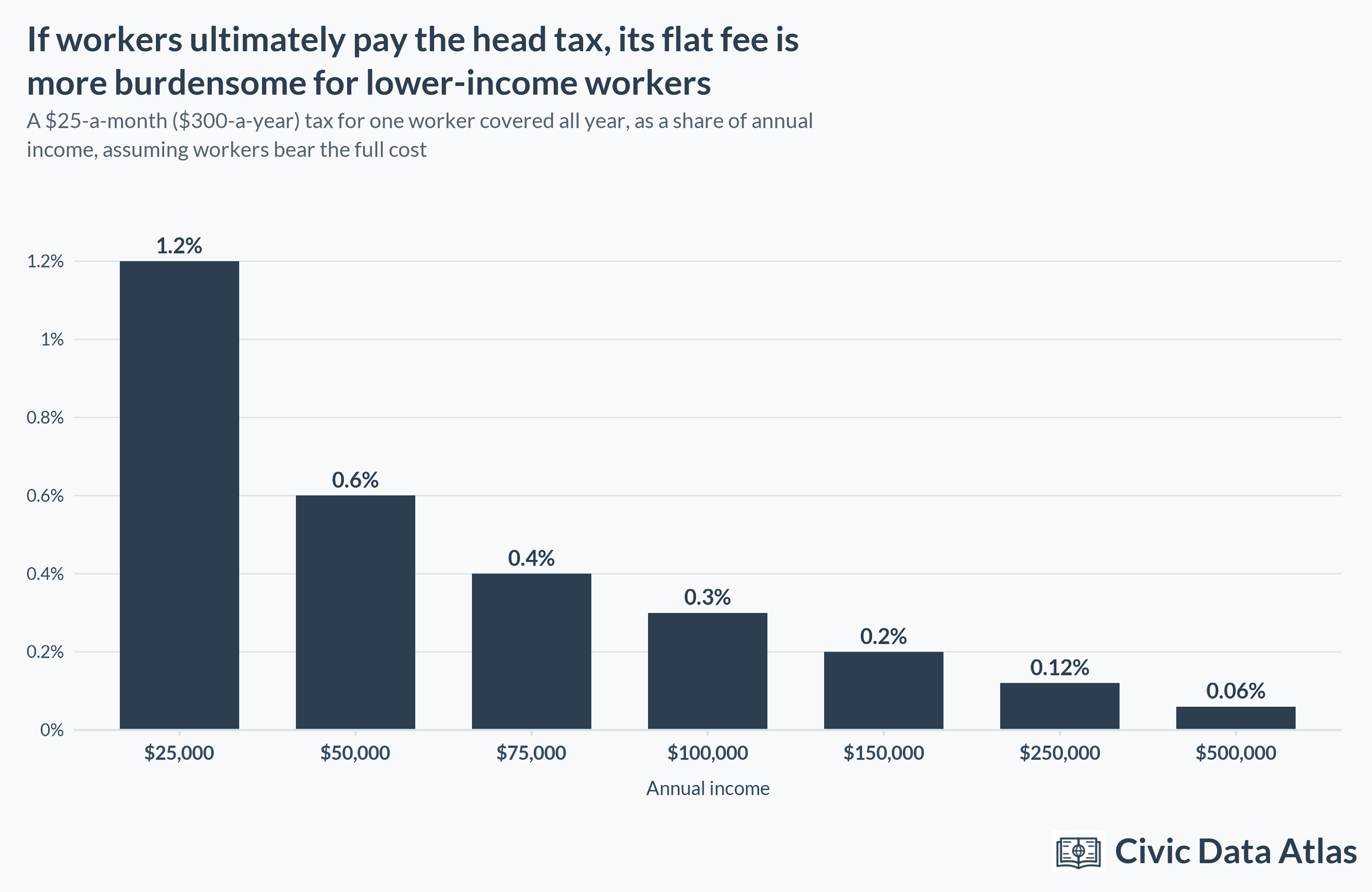
The same logic implies that if the head tax discourages hiring, it discourages hiring low-wage workers much more than high-wage ones, because the tax is a much larger share of their total compensation. For example, for a firm employing someone who earns $100,000 a year, the head tax would raise the firm’s total compensation cost for that worker by 0.23%. For an employee working full time at Chicago’s minimum wage, the increase would be 0.69%—roughly three times as large.4
Who qualifies for exemptions from the head tax
Determining whether businesses or workers ultimately absorb the tax, or how much it changes hiring decisions, is beyond the scope of this analysis.5 Instead, this report focuses on quantifying the reach of the proposed exemptions. Both the regressivity argument and the hiring argument are stronger the more the head tax falls on low-income employees rather than high-income ones. Even if you accept that the head tax falls on workers and discourages hiring, exemptions could make it less regressive and weaken the hiring disincentive compared with a tax on every worker.
The table below summarizes the exemptions in Mayor Johnson’s latest head tax proposal.
| Category | Details |
|---|---|
| Low quarterly pay | Workers who never reach $4,300 of earnings in a calendar quarter from one employer (about 20 hours per week at Chicago’s minimum wage). |
| Small employers | Employers with fewer than 125 covered workers do not pay the tax. |
| Work outside Chicago | Workers who do less than half their work in Chicago during the quarter are not subject to the tax. |
| Nonprofit employers | Nonprofit organizations do not pay the tax. |
| Government jobs | Federal, state, and local government employers do not pay the tax. |
| Workers in socioeconomically disadvantaged areas | Employers can claim a rebate for the full tax for each covered worker who spends most of their monthly work hours in a designated disadvantaged census tract. |
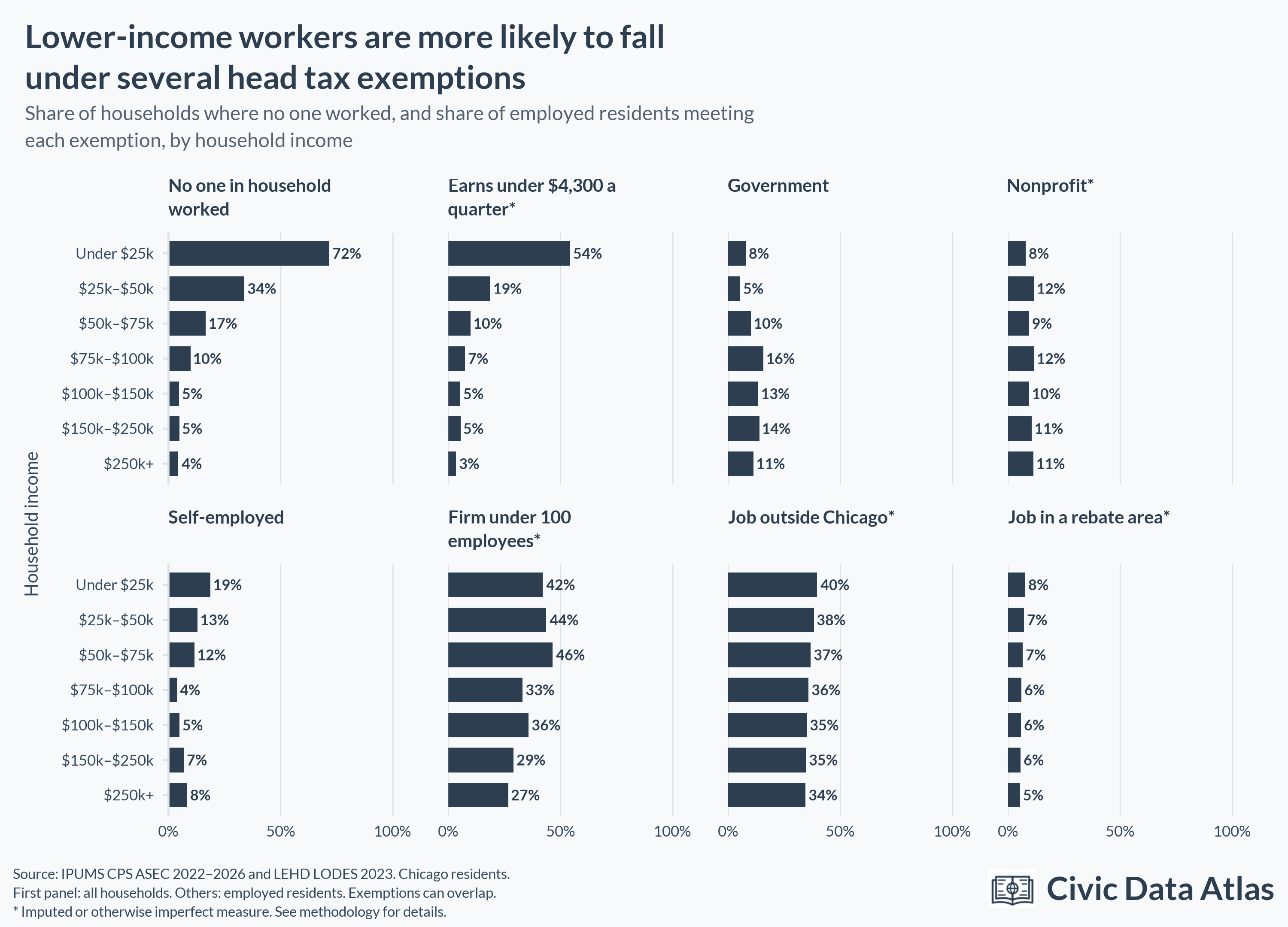
Using Census survey and administrative data, the graph below shows, by household income, the share of households where no one worked (first panel) and the share of employed residents who qualify for each exemption (panels 2–8). Some exemptions can only be approximated with available data; those are marked with an asterisk and explained in the methodology. Data limitations likely lead us to overestimate the percentage of Chicago residents subject to the head tax.6
The first two panels show that very low-income households are unlikely to include anyone who works, and when they do, that worker often does not earn enough in a quarter to be subject to the tax. Government work is more common in middle- and higher-income households; nonprofit work is about equally common at every income level. Self-employment, working for a small employer, and working outside Chicago are more common for low-income households. Finally, jobs in rebate areas are more common among workers in low-income households, but they are rare overall, which limits the reach of this exemption.7
The impact of the head tax by income
The graph below combines all the exemptions to estimate the percentage of households at each income level with at least one member subject to the head tax. Overall, we estimate that 26% of Chicago-resident workers would be subject to the tax. At the household level, coverage is strongly related to income: an estimated 3% of households earning under $25,000 and 15% of those earning $25,000 to $50,000 would include a covered worker, compared with 51% of households earning $250,000 or more.
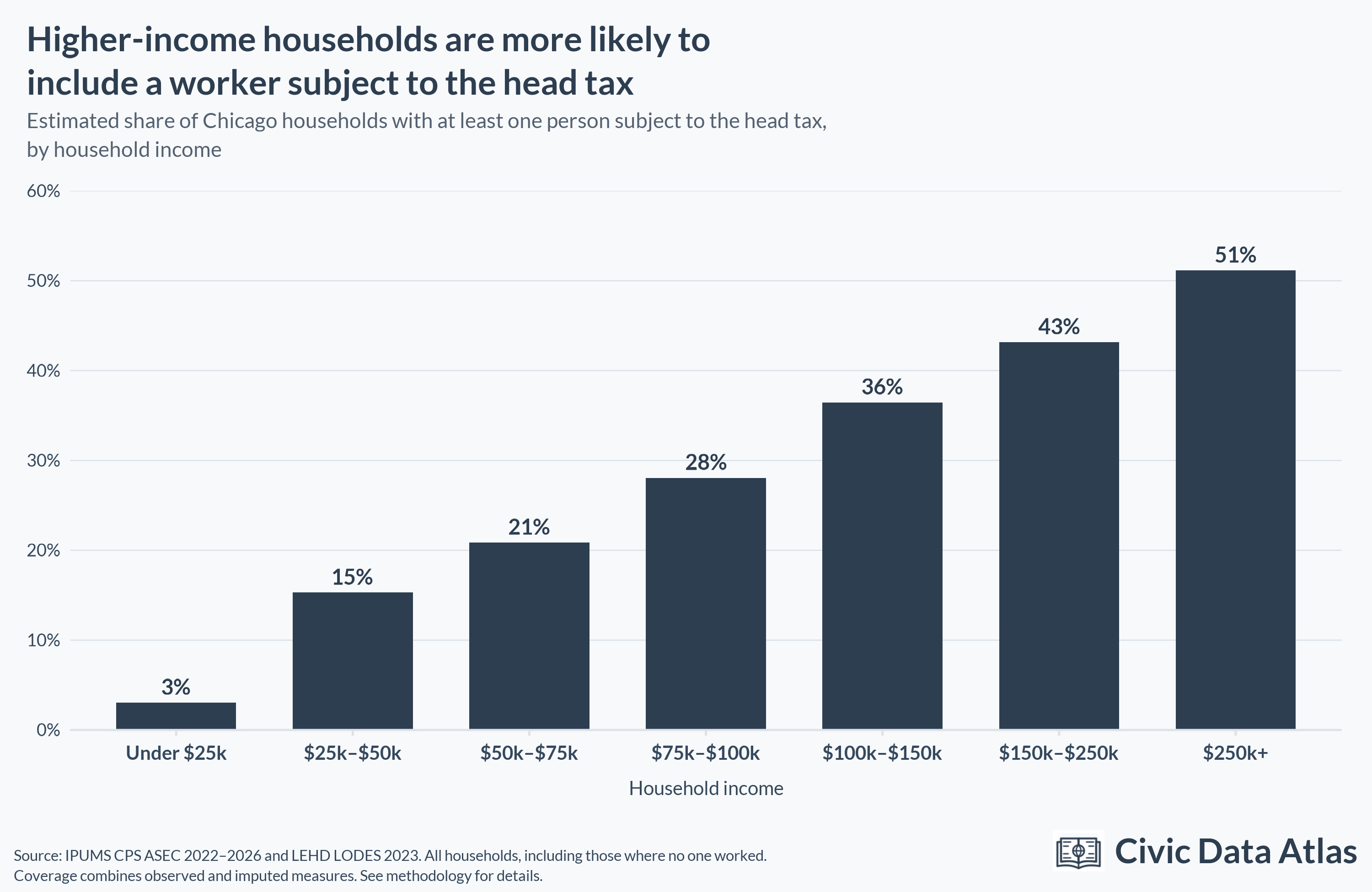
While high-income households are more likely to include a worker subject to the tax than low-income households, this does not mean the tax is progressive. If workers, rather than businesses, ultimately pay the full tax, its flat-fee design still pushes it in a regressive direction.
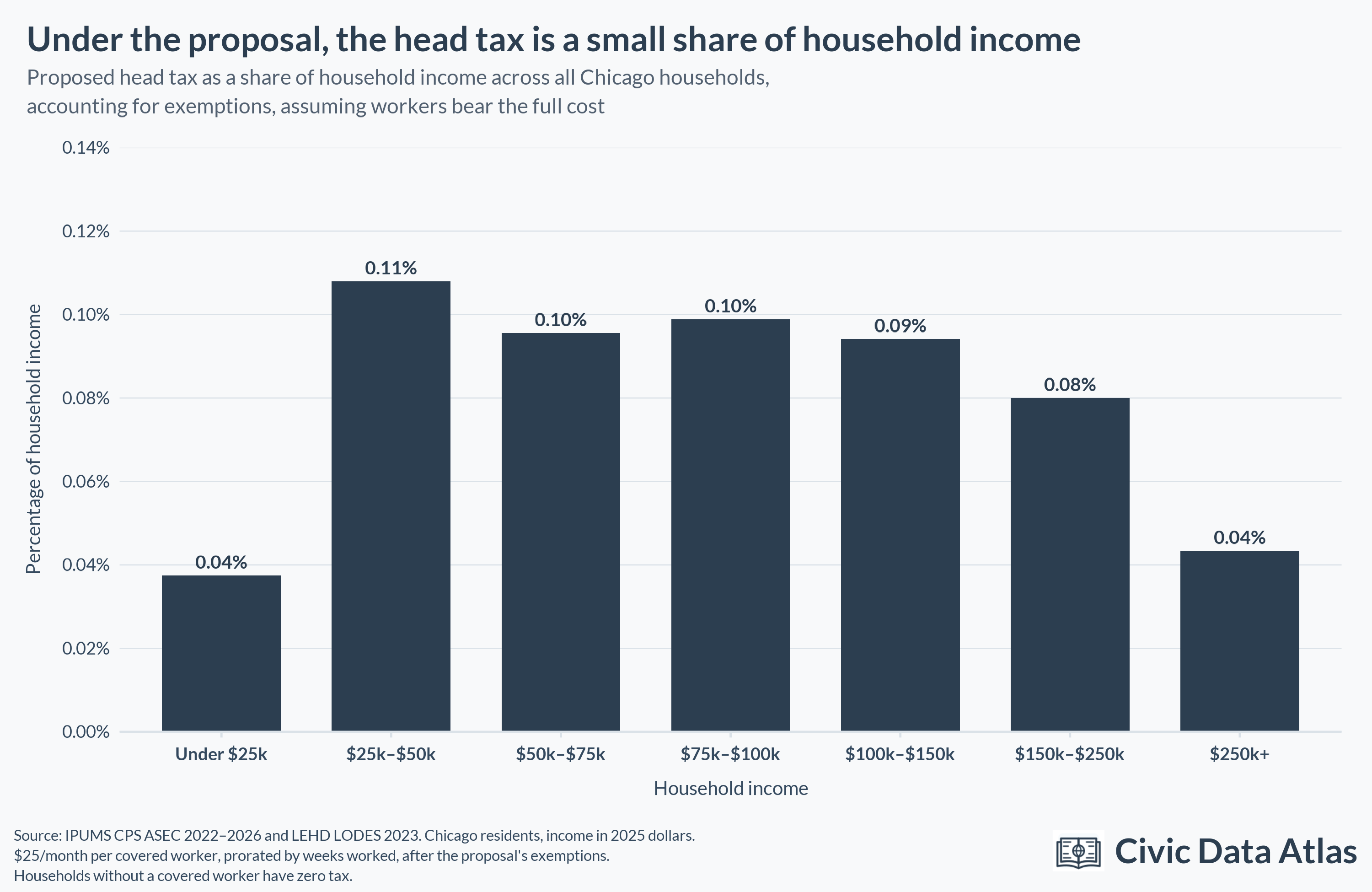
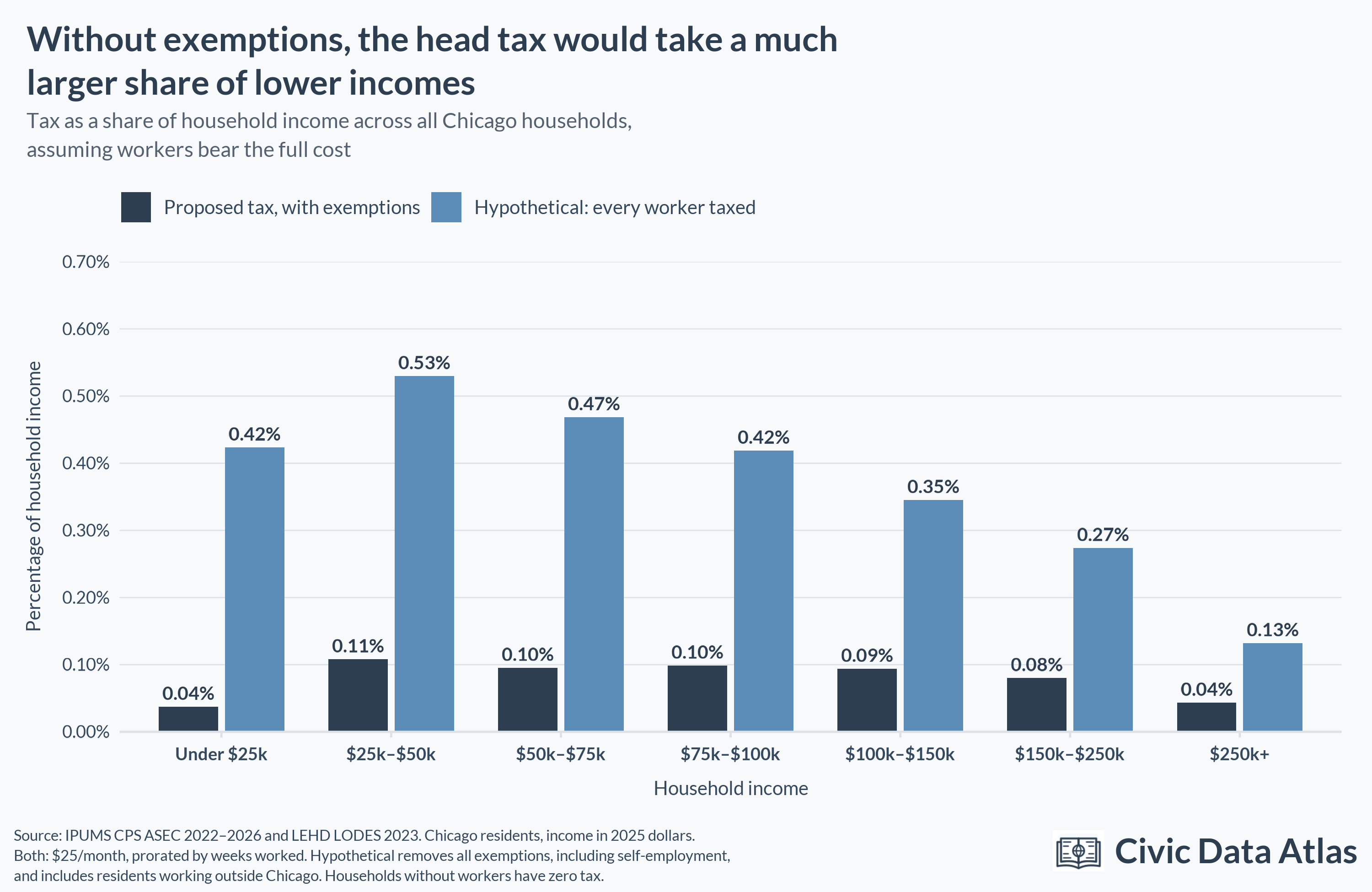
The graph below shows the head tax as a percentage of household income for different income levels after accounting for all the exemptions. Households earning $25,000 to $150,000 pay a slightly larger share of income than higher-income households, especially those earning over $250,000. Households with annual incomes under $25,000 pay the smallest share, because households at that income level rarely include a covered worker.
Across income groups, the average head tax burden is a small share of household income: for instance, households earning $25,000 to $50,000 would pay about $40 a year on average, just over 0.1% of their income. And that figure rests on the assumption that workers bear the tax. If businesses instead pay it out of profits, workers would bear none of it, and because profits flow mostly to higher-income owners and shareholders, the tax would be strongly progressive.
To show how the exemptions affect the head tax’s regressivity, the graph below compares the proposal with a version that taxes every working Chicago resident. With no exemptions, the tax would be quite regressive: lower-income households would pay more than 0.4% of their income, while the highest-income households would pay just 0.13%. With the exemptions, households with incomes under $25,000 a year pay very little, and households earning between $25,000 and $250,000 pay similar shares of their income. Only households with very high incomes ($250,000 or more) pay a substantially smaller share of their income than middle-income households.
The impact of the head tax on hiring incentives
The exemptions have a similar effect on the head tax’s hiring incentives. The graph below shows the head tax as a percentage of total compensation at each wage level.8 If every wage job were taxed, the tax would equal over 1% of compensation for the lowest-wage workers. But because many low-wage workers are exempt, the proposed tax amounts to just 0.14% of total compensation for Chicago-resident wage and salary workers earning less than $50,000 a year, averaged across covered and exempt workers.
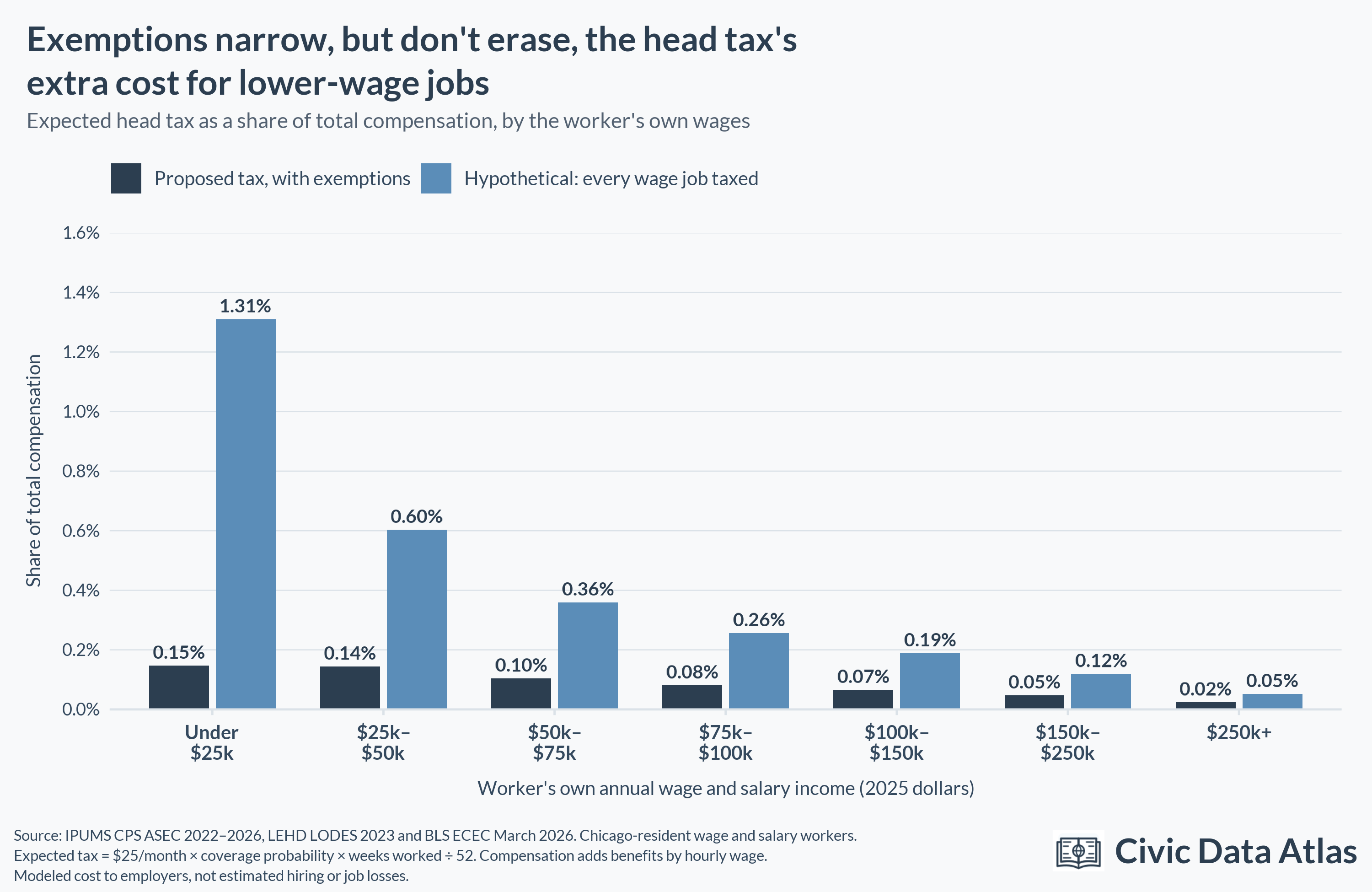
Both the small burden on lower-income households and the small increase in the cost of hiring lower-wage workers are driven mostly by the fact that most low-income workers are not subject to the head tax. Arguably, averaging across all workers (most of whom aren’t subject to the tax) can give a misleading picture of the tax’s impact. In the extreme, imagine a tax of $10,000 per employee that applied to only 1% of Chicago jobs. Averaged across all jobs, the added cost would be just $100 per worker ($10,000 × 1% = $100). But for the firms that did have to pay it, a $10,000 tax would be a severe hiring disincentive.
The mayor’s latest head tax proposal is nowhere near that extreme. But even though exemptions dilute its aggregate impact, it’s worth quantifying how burdensome it is for the firms that would pay it. The example below shows the head tax’s impact on a hypothetical firm with 1,000 employees, 90% of whom earn the minimum wage—a wage mix that would make the head tax especially burdensome.9 For that firm, the head tax would add about half a percent to total compensation costs.
How the hypothetical firm's costs add up
| Workers | Annual wage | Compensation per worker | Head tax, % of compensation | Total compensation | Total head tax |
|---|---|---|---|---|---|
| 900 low-wageFull time at Chicago's $17.05 minimum wage | $35,464 | $43,434 | 0.69% | $39.1M | $270,000 |
| 50 mid-wage | $75,000 | $98,547 | 0.30% | $4.9M | $15,000 |
| 50 high-wage | $150,000 | $196,624 | 0.15% | $9.8M | $15,000 |
| Firm total, 1,000 workers | 0.56% | $53.8M | $300,000 |
Assumes every worker works full time all year for a for-profit employer, works mostly in Chicago and outside a rebate area, and meets the $4,300 quarterly earnings test. Total compensation adds employer benefit costs from BLS's March 2026 compensation survey, as in the examples above. The percentages are the same at any firm size that meets the 125-worker threshold; a firm with the same wage mix but only 100 workers would be exempt.
For a firm considering hiring an additional part-time worker who earns the minimum wage, receives no benefits, and earns just above the tax threshold, the increase in compensation costs would be 1.7%. That’s equivalent to a $0.29 hourly raise, about two-thirds of the July 2026 inflation adjustment to Chicago’s minimum wage.10
Critics of the head tax argue that a flat per-worker fee is regressive and discourages hiring low-wage workers, for whom $300 a year is a larger share of compensation. If we assume that the head tax leads to lower wages and less hiring rather than simply reduced profits, a flat per-worker fee is regressive and weighs most heavily on low-wage jobs. But the mayor’s proposal is not a flat fee on every worker. Its exemptions—for low quarterly earnings, small employers, nonprofits, government, work outside the city, and jobs in disadvantaged areas—are, taken together, much more likely to exclude lower-income workers. As a result, households earning between $25,000 and $250,000 pay roughly similar shares of their income, and in aggregate the tax adds only a small fraction of a percent to the average cost of hiring a low-wage worker in Chicago. The exemptions do not make the tax progressive, but they blunt the regressivity that a no-exemption version would have. With those exemptions, the tax is more progressive than some other revenue options available under Chicago’s strict limits, such as increasing fees for municipal garbage pickup.
Methodology
Data and population. The estimates pool Current Population Survey Annual Social and Economic Supplement (CPS ASEC) surveys from 2022 through 2026 for Chicago residents. The results describe Chicago residents, including those working outside the city; they do not describe all jobs located in Chicago or include suburban commuters into the city.
Quarterly earnings. The survey does not report earnings by calendar quarter from each employer. We estimate pay in the highest-earning quarter on the longest-held job using annual earnings and weeks worked, assuming steady weekly earnings, and compare it with the $4,300 threshold. For instance, for someone who reported working year round and earning $20,000, we’d assume earnings of $5,000 per quarter, enough to meet the earnings test all year. However, their earnings could have varied across quarters, leaving them subject to the head tax for only part of the year.
Nonprofit employment. The ASEC does not distinguish nonprofit from for-profit private employers. We link workers to the March basic CPS, which does make that distinction. That response concerns the current job, which may differ from the preceding year’s longest job. Where the linked status is unavailable, we assign a for-profit probability estimated among linked workers who meet the earnings and firm-size tests in the same household-income group. The linked status is available for 590 of the 934 workers in our sample who meet the earnings and firm-size tests.
Employer size. The CPS reports only how many employees a worker’s employer has nationally, not in Chicago. We use it to estimate the share of workers at firms with fewer than 100 employees. This overstates coverage among workers at large national firms with fewer than 125 employees in Chicago. Because the data are self-reported, workers at individual franchises of national chains may report the chain’s national employment rather than their franchise’s, which is the relevant unit for the head tax. Finally, we use a cutoff of 100 employees rather than 125 because the survey reports employer size only in ranges. The nearest boundary to 125 is at 100, between the 25-to-99 and 100-to-499 ranges, so firms with 100 to 124 employees cannot be separated from larger ones.
Workplace location and rebate areas. The CPS does not record where individuals work. To model rebate areas and work outside Chicago, we use Census LEHD Origin-Destination Employment Statistics (LODES) for 2023, the most recent available data, to estimate the shares of Chicago residents’ private-sector jobs located outside Chicago and in designated disadvantaged census tracts. We calculate these shares separately for jobs paying $1,251–$3,333 per month and more than $3,333 per month, following the LODES earnings categories. For each CPS worker, we estimate monthly pay from earnings on their longest-held job and weeks worked, then assign the workplace probabilities for the corresponding earnings group. The worker’s expected tax is multiplied by the estimated probability of working in Chicago and, conditional on working in Chicago, the probability of working outside a rebate area. All workers in the same earnings group receive the same workplace probabilities. LODES relies on employers to report job-site locations, but some do not report multiple worksites separately. In those cases, the Census Bureau may assign all of an employer’s workers in a state to the employer’s main reported address, such as a headquarters, which can place jobs in the wrong tract, in or out of a rebate area, or in or out of Chicago.
Expected tax as a share of compensation. For the hiring-incentive figure, the sample is limited to wage and salary workers, who are grouped by their own annual wage and salary income in 2025 dollars (self-employed and zero-wage workers are excluded, since they have no modeled coverage). Each worker’s expected tax is $300 multiplied by their modeled probability of coverage and by weeks worked divided by 52. Total compensation adds employer benefit costs to wages using the national private-industry benefit costs by wage percentile from BLS’s March 2026 compensation survey, Table A, interpolated by each worker’s hourly wage (annual wages divided by usual weekly hours and weeks worked), the same method used for the minimum-wage and $100,000 examples above. Each bar is the group’s total expected tax divided by its total compensation.
Footnotes
For instance, the Center on Budget and Policy Priorities writes in its federal payroll tax explainer that while employers pay Social Security and Medicare taxes, “most economists agree that employees bear the cost of employer payroll taxes in the form of lower wages.”↩︎
Even a payroll tax that is a percentage of wages can be regressive because high-income Americans get more income from businesses and investments than from wages.↩︎
The tax is structured this way due to constraints on how Chicago can raise revenue: the Illinois Constitution bars home-rule cities from taxing income or earnings unless explicitly authorized, so Chicago cannot levy a payroll tax that is a percentage of wages on its own.↩︎
The proposed tax is $25 per month, or $300 annually, for each taxable employee. At Chicago’s current $17.05 minimum wage, 40 hours per week for 52 weeks produces annual base pay of $35,464. Using national private-sector benefit costs by wage percentile (which include costs such as health insurance and employer-side payroll taxes) from BLS’s March 2026 compensation survey, we estimate total annual employer compensation of $43,434 for the minimum-wage worker and $131,200 for the $100,000 worker.↩︎
Some may argue that even if this iteration of the head tax is not large or broad enough to discourage hiring or hinder workers, it sets a precedent for this kind of tax that will likely be raised in the future to a level that would have a more significant impact.↩︎
Our estimates imply the head tax would raise about $110 million per year, similar to the mayor’s office estimate of $101 million. However, our data cover only Chicago residents—many commuters into Chicago would also be subject to the head tax, raising substantial additional revenue. This suggests that limitations such as knowing only an employer’s national workforce size, rather than its Chicago workforce size, likely lead us to overestimate the share of residents subject to the head tax.↩︎
Our full analysis of the rebate found that 13% of Chicago jobs paying $15,000–$40,000 a year are in a disadvantaged area, compared with 8% of jobs paying more. The income differences in this figure are smaller, for two reasons. First, this figure groups workers by household income rather than by the pay of their own job. Many lower-paid workers live in higher-income households, which narrows the gap. Second, the shares here are of all jobs held by Chicago residents, including jobs outside the city, where the rebate does not apply. The rebate analysis counts only jobs located in Chicago. About 40% of residents’ lower-paying jobs are outside the city according to LODES data, which lowers every share here, most of all for lower-paid workers.↩︎
Compensation includes wages plus average benefits and employer-side taxes, from BLS’s March 2026 compensation survey. Because an employer’s cost depends on the worker’s own pay, not their household’s income, this section groups workers by their own wages.↩︎
The more a firm’s workforce is made up of lower-wage employees, the larger the head tax is as a share of total compensation.↩︎
A worker paid Chicago’s $17.05 minimum wage for 20 hours a week earns $17,732 a year, or about $4,430 a quarter, just above the $4,300 quarterly earnings threshold. With no benefits, the $300 annual tax adds 1.7% to the cost of employing them. Spread over 1,040 hours a year, that is $0.29 an hour, about 64% of the $0.45 increase in Chicago’s minimum wage on July 1, 2026, from $16.60 to $17.05.↩︎