What Wards Would Be Most Impacted By Increasing Chicago’s Garbage Fee?
Summary
- 57% of Chicago households live in 1-4-unit buildings that would be subject to a garbage fee increase. Counting only owner-occupants, 35% of Chicago households would pay for any increase.
- Alderpeople who voted to pass Chicago’s 2026 budget have a higher share of constituents who would be subject to a garbage fee increase than those who voted against it.
- Although higher-income households are more likely to be subject to a garbage fee increase, the fee is flat and does not vary by income, so any increase would be regressive.
Background
During last year’s budget negotiations, alders debated increasing the fee Chicago charges for garbage disposal. For single-family homes and apartments with fewer than five units, Chicago provides municipal garbage disposal services and charges households $9.50 per month.1 The fee covers only about 40% of the city’s annual refuse-collection costs. This gap has led to repeated proposals to raise the fee: the Chicago Financial Future Task Force recommended increasing it to cover a more substantial portion of the city’s total cost, including a modeled increase to $55 per month to cover total Department of Streets and Sanitation operating costs.
While an increase in the garbage fee was ultimately not adopted as part of the 2026 budget, it’s likely to come up again in this year’s negotiations as Chicago continues to experience budget pressures.
What Wards Would Be Most Affected?
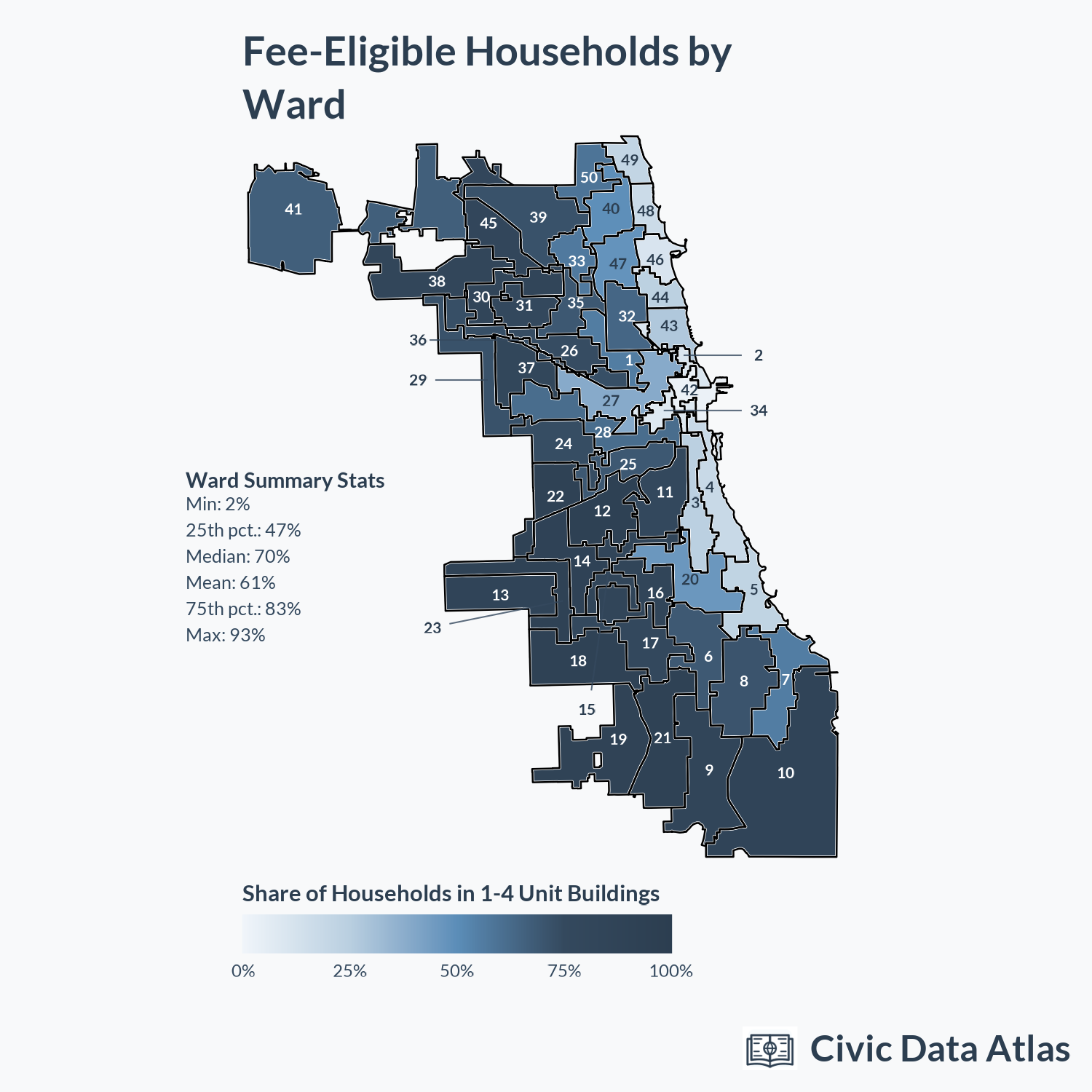
Civic Data Atlas’s ward-level demographic statistics can be used to estimate how many households would be subject to a garbage fee increase. The map below shows the fraction of households living in 1-4-unit buildings by ward. Downtown and lakefront wards are less impacted, but the vast majority of wards have a substantial share of constituents who pay the city for garbage pickup. Overall, 57% of Chicago households live in 1-4-unit buildings that would be subject to any garbage fee increase.
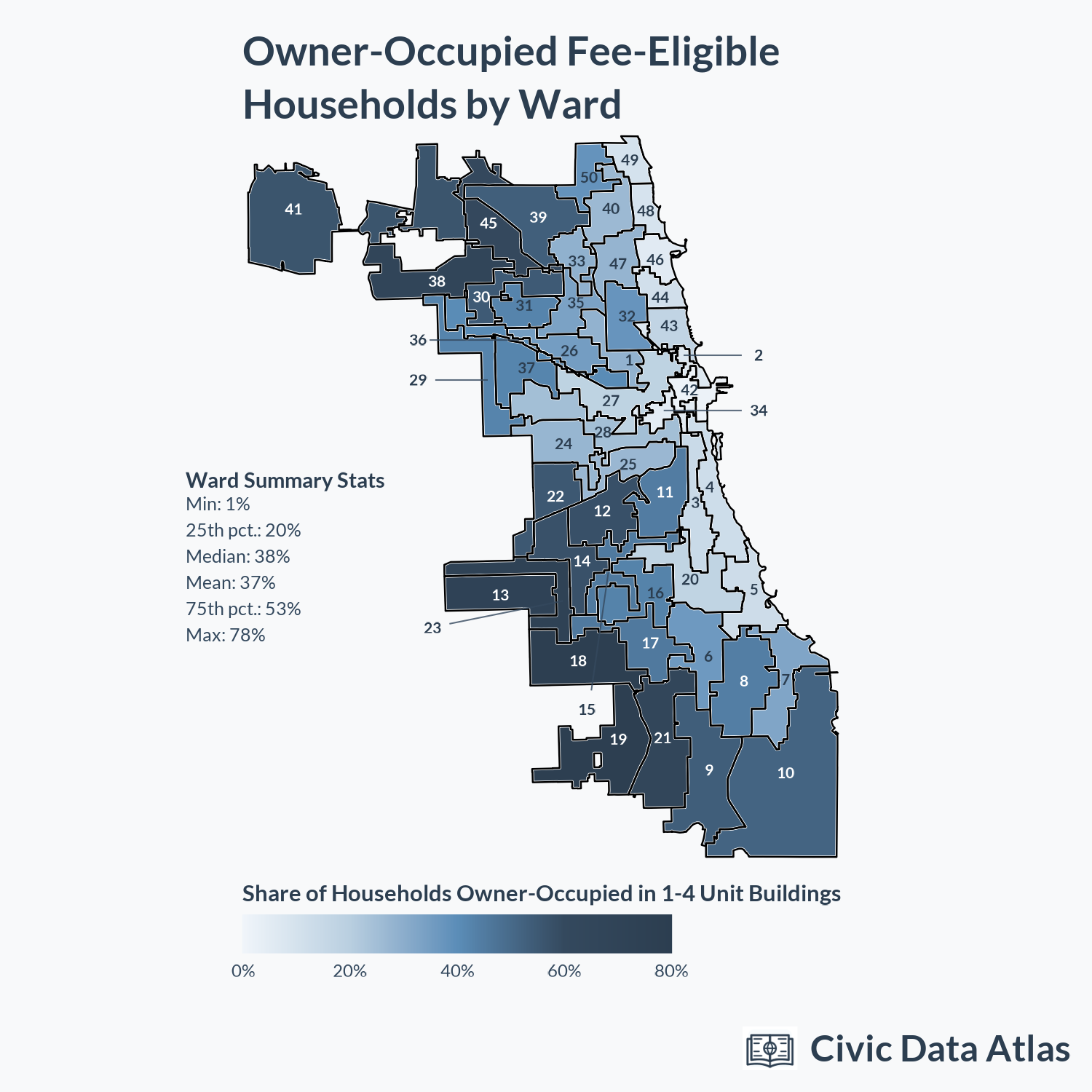
A garbage fee increase would apply to all buildings with four or fewer units; however, most renters do not directly pay the garbage fee.2 While landlords could pass an increase through to renters as higher rents, it is also relevant to analyze the share of 1-4-unit buildings that are owner-occupied and would be directly subject to a fee increase, as shown in the map below.
The pattern of ward-level exposure is consistent between the two measures: downtown and lakefront wards remain the least exposed. However, when focusing on owner-occupied units only, far fewer households are subject to the fee increase: of the 57% of Chicago households that live in 1-4-unit buildings, 39% are renters, leaving just 35% of all of households in owner-occupied 1-4-unit buildings directly subject to the fee.
Are Lower-Income Households Disproportionately Impacted?
One recurring theme during the debate over the garbage fee was whether it weighed more heavily on lower-income households. Ald. Jason Ervin (28th) called it a “regressive tax on some of our poorest citizens” while the prominent Chicago policy Substack A City That Works called it “progressive” and sound policy in part because “wealthier areas with larger homes pay more.”
Higher-income households are somewhat more likely to live in units subject to a garbage fee increase. Almost 40% of Chicago households with incomes above $150,000 live in fee-eligible units, while less than a quarter of the lowest-income households live in such units.
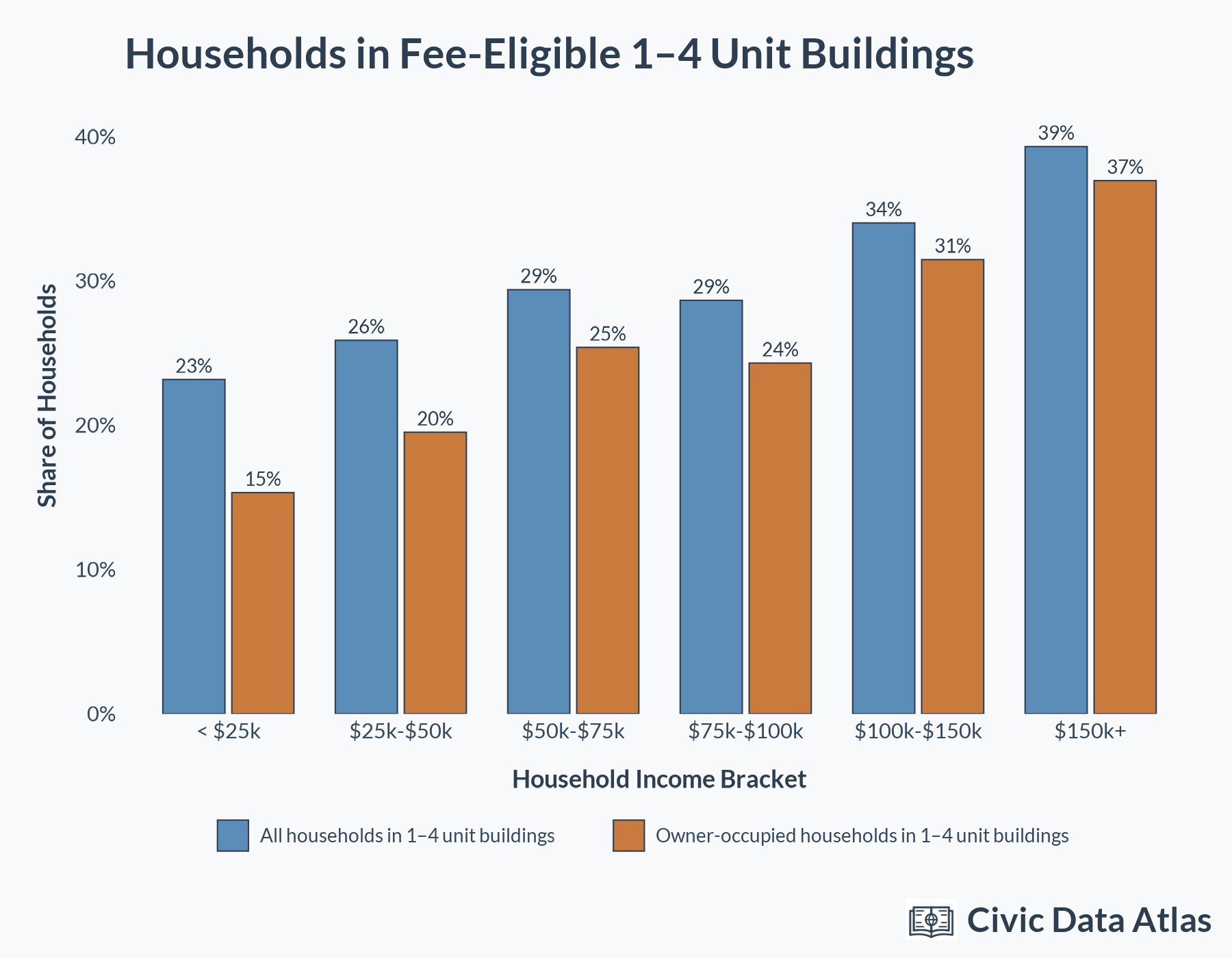
However, because the garbage fee does not vary with a homeowner’s income level, it is far more burdensome for low-income households who do have to pay. For instance, a household with an annual income of $25,000 would spend 2.6% of its income on a $55-per-month garbage fee increase, while a household making $125,000 would spend just 0.5%. The graph below translates this logic to the entire Chicago population, showing how a garbage fee increase would affect households of different income levels via the change in their after-tax income.3 Calculating the change in after-tax income is the standard way of assessing a policy’s progressivity or regressivity.
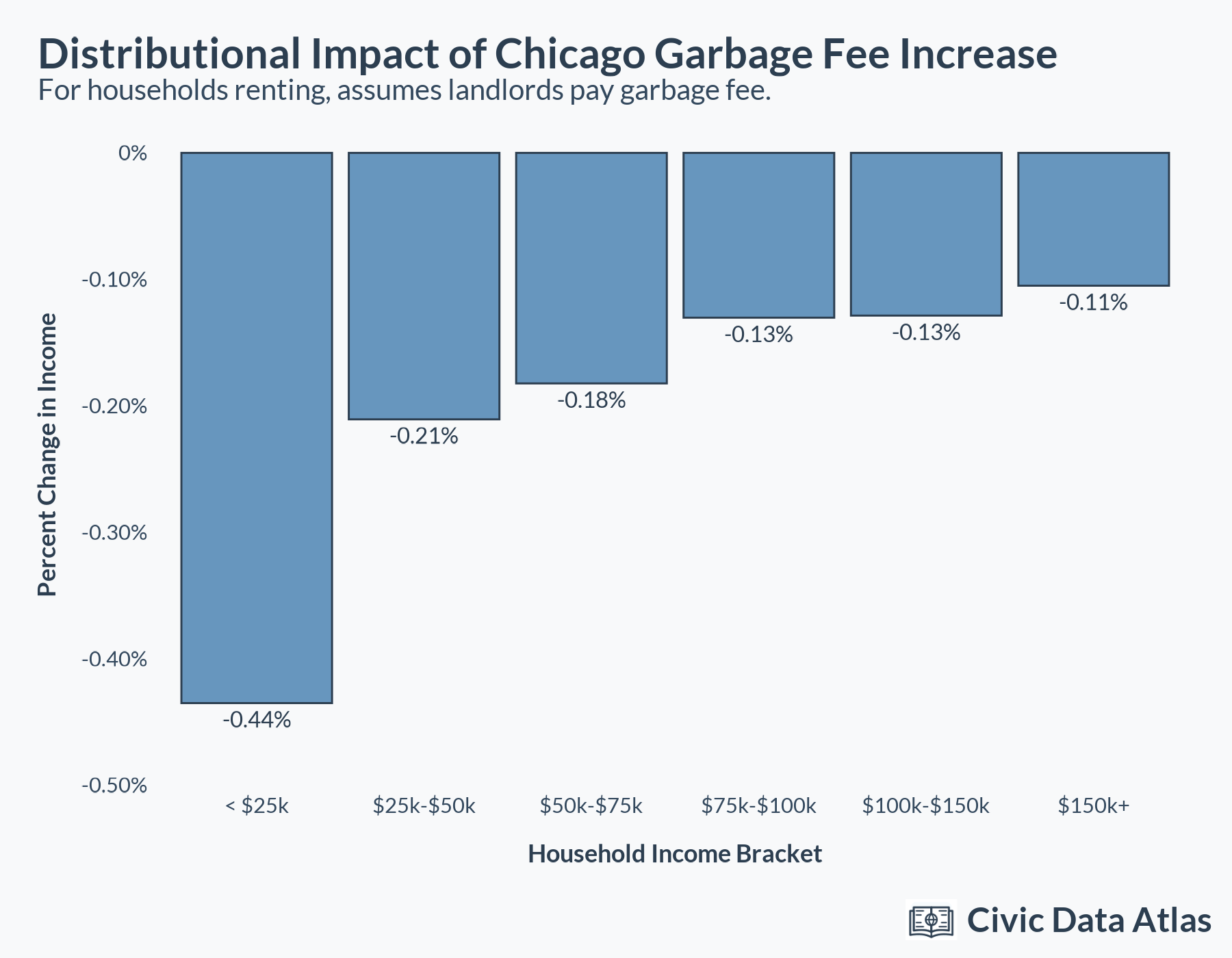
The results show a garbage fee increase would be regressive. While low-income households are less likely to be subject to the fee, it is a far more painful increase for the low-income households who do have to pay relative to those in higher income brackets. This differential impact by income is far more important than the fact that low-income households are more likely to live in larger apartments not subject to the fee increase.4
Other Policy Considerations
A full analysis of the regressivity of a garbage fee increase needs to consider the status quo. Currently, Chicago is paying the extra cost of garbage collection. While making households pay for their garbage services is regressive, it is possible that it is less regressive than the standard way Chicago raises revenue via property taxes.
There are also policy considerations beyond the fee’s distributional impact. For instance, subsidizing garbage collection for single-family homes while making larger apartments pay the full cost will, at the margin, discourage denser housing. Furthermore, aligning fees with the cost of service provision could be viewed more positively by constituents than other ways of raising revenue where the relationship between extra costs and government services rendered is more ambiguous.
Alternative Budget Coalition and the Garbage Fee
In the 2026 budget negotiations, an increase to the garbage fee was debated but never adopted. This may in part be explained by the fact that the coalition of alders that voted for the budget would have been disproportionately impacted by such a fee increase, as shown below.
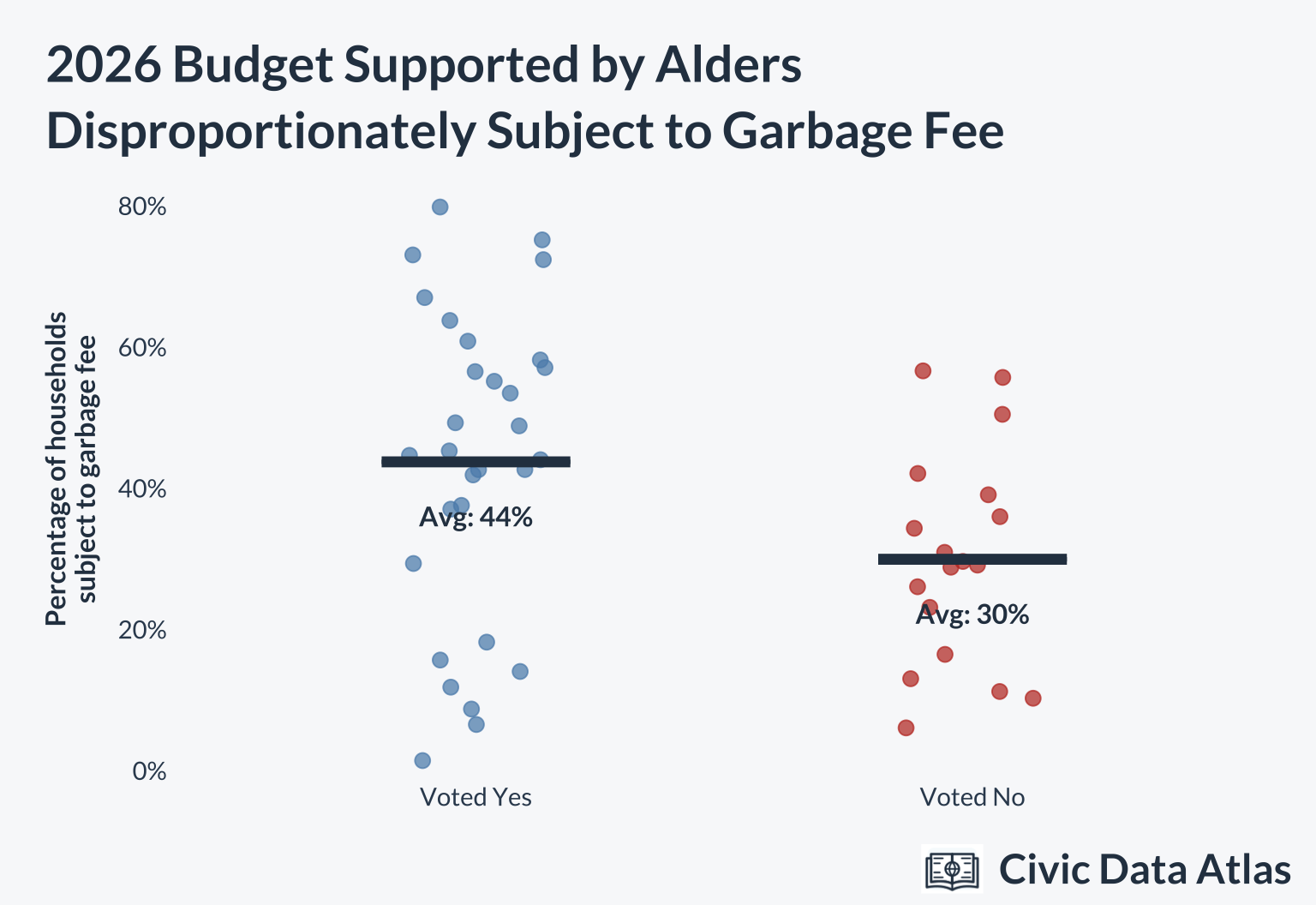
Among the 30 alderpeople who supported the 2026 budget, the average ward has 44% of households that are owner-occupied in 1-4-unit buildings — and would directly pay any garbage fee increase. For the 18 alders who voted no, the average is 30%. The yes coalition skews toward the bungalow-belt wards of the Northwest and Southwest sides, where small single-family homes dominate. The no coalition is more concentrated in wards with large apartment buildings — both high-rise downtown wards and dense progressive wards on the North Side — as well as several South and West Side wards where fewer households own their units. If the same group of alders comes together to support a 2027 budget, they may be reluctant to include a garbage fee increase that disproportionately falls on their own constituents.
Ward-Level Data
Footnotes
Buildings with more than 4 units must pay for private garbage disposal, and senior owner-occupants subject to the fee get a 50% discount.↩︎
The garbage fee is part of the water and sewage bill and cannot be taken out of the owner’s name, unlike electricity and gas.↩︎
The graph assumes an increase up to $55 per month to be in line with the consultant report recommendations that brings the cost up to the cost of service. A different fee increase would have the same relationship to income, with the decrease in after-tax income proportionally smaller.↩︎
The graph only assigns the impact of the higher fee to owner-occupants. If any part of the garbage fee is passed through to renters via higher rents, the decrease in income for low-income households would be larger, because low-income households disproportionately rent.↩︎