Where Video Gambling Applications Stand in Chicago
Ward-level license counts and revenue estimates
Summary
- 347 Chicago establishments have applied for video gambling terminals: 54 are licensed and 293 remain pending in the latest Illinois Gaming Board list, retrieved August 27, 2026.
- Among Illinois establishments with six or fewer terminals, average net terminal income was $372,000, but the median was $276,000. If all 347 applicants operated for a full year, that implies roughly $6.5 million in municipal gaming-tax revenue using the mean, or $4.8 million using the median.
- While Chicago receives 5% of net income from video terminals, it receives roughly 12% from Bally’s operations. In other words, for every dollar lost by a gambler at a video terminal, Chicago gets 5 cents, while every dollar lost at Bally’s yields Chicago at least 12 cents.
Data from the Illinois Gaming Board shows that hundreds of Chicago businesses have applied for a video gambling license, even though no video gambling terminals are currently operating in the city. Chicago legalized video gambling terminals as part of the 2026 budget, but Mayor Brandon Johnson is now reportedly pushing for an ordinance that would re-ban them before any terminals begin operating.
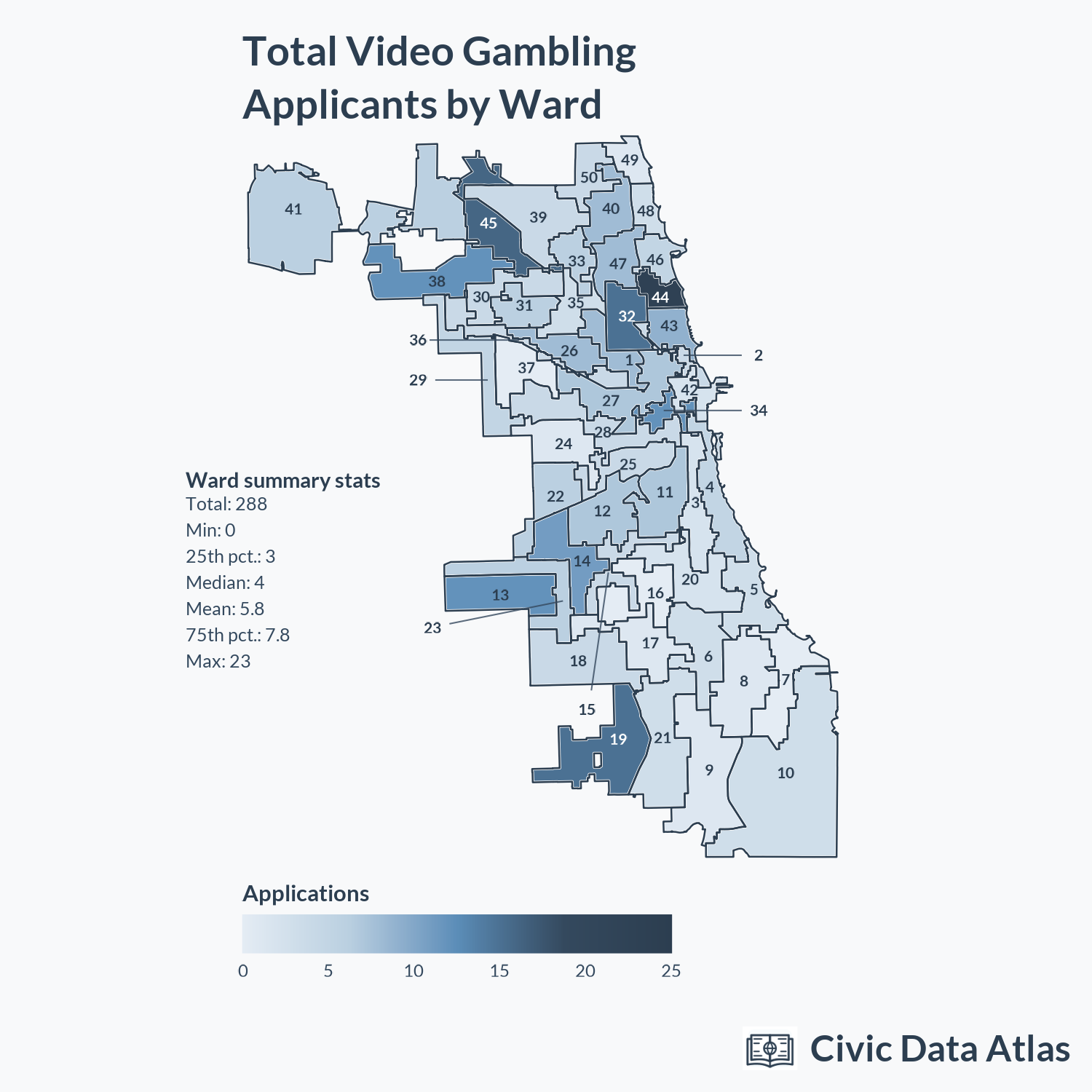
The map below shows the number of establishments that have applied for a video gambling license in each ward. There are 347 total applications in the latest snapshot, retrieved August 27, 2026. This is far short of the projections behind the 2026 budget that legalized the terminals, under which 2,640 establishments were expected to apply and bring in $6.8 million of terminal licensing fee revenue.1
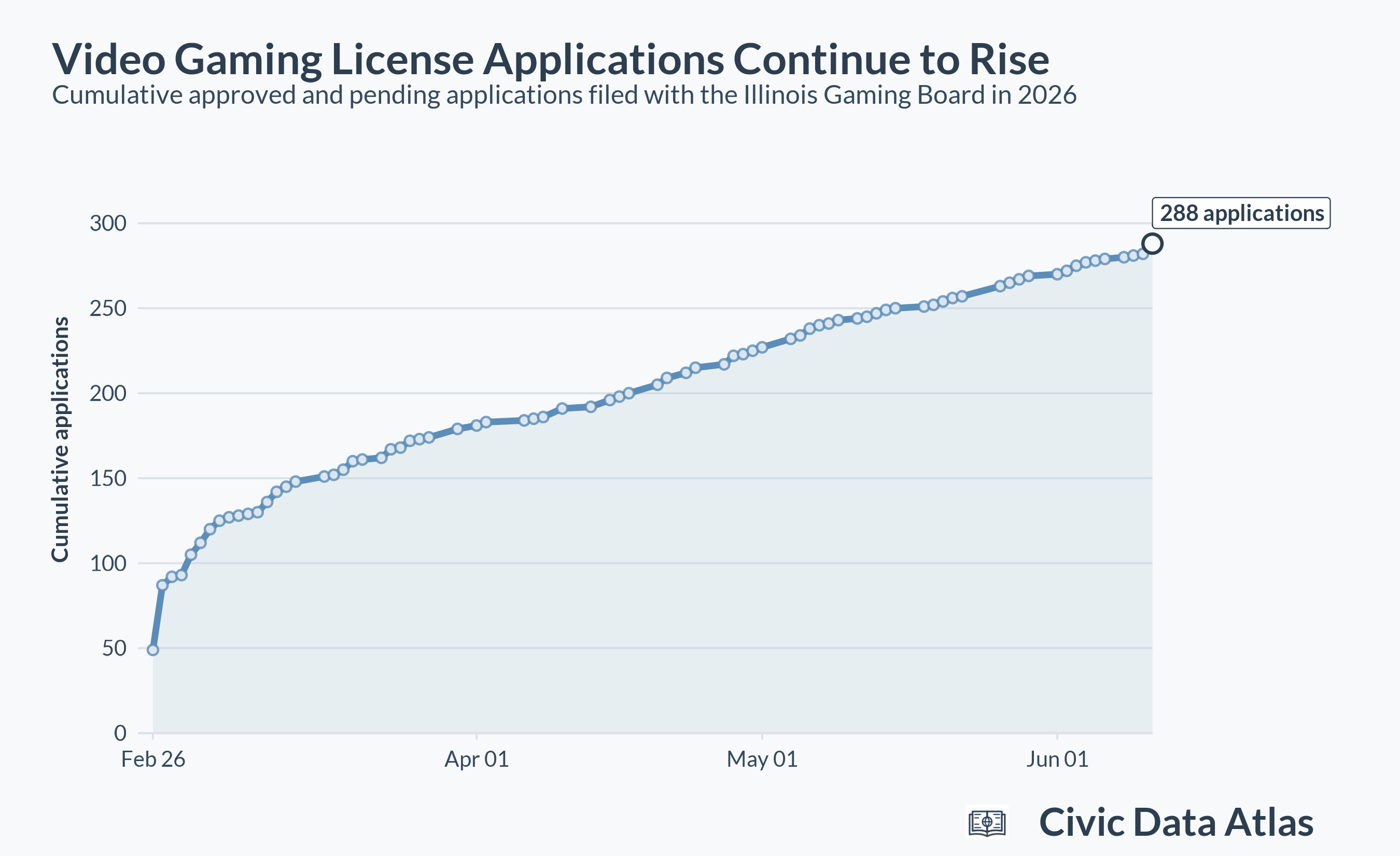
Are applications still rising, or has demand already begun to level off? The graph below tracks the number of applications filed over time.2 After an initial surge when applications opened in early 2026, applications have continued to climb steadily, with little sign of tapering off. Even at the current pace, however, it would take years before the city reached the 2,640 establishments that the 2026 budget projected.
While the 2026 budget is likely to overestimate terminal license fee revenue, it may have underestimated the potential for some establishments to begin operating terminals in 2026. Because of the long processing timeline for the Illinois Gaming Board to approve new applications, the budget relied only on licensing revenue, not revenue from terminal operations. The current Illinois Gaming Board list includes 54 Chicago establishments with approved state licenses. While these establishments will still require city-level licenses before they can begin operating, there currently appears to be no city process in place to issue those licenses. If that changes, the city could receive gambling revenue in addition to any initial licensing revenue in 2026.
How much revenue would terminals raise once in operation? We can use data from existing video gambling establishments to get a rough estimate, but the choice of comparison group matters. Chicago’s municipal code limits a licensed location to six terminals, so this analysis uses the 9,157 Illinois establishments in the report with six or fewer terminals rather than including larger truck stops.3
For those establishments, the average amount played during the roughly one-year reporting period was $4.0 million and the average amount won was $3.7 million, leaving average net income of $372,000. The median establishment was smaller: $3.0 million played, $2.8 million won, and $276,000 in net income.4
The tax calculation is straightforward: $372,000 average net income × 35% = $130,000 in total taxes; the municipality receives 5% of net income, or approximately $18,600 per establishment per year. The median municipal share is approximately $13,800. The remaining 65% is split equally between the terminal operator and the establishment, leaving the average establishment with roughly $121,000 before its own expenses.
If all 347 current applicants were approved and operated for a full year, they would yield Chicago approximately 347 × $18,600 = $6.5 million in municipal tax revenue, using the average establishment. Using the median establishment instead would yield approximately 347 × $13,800 = $4.8 million.
Chicago would also benefit from license revenue. Under the city’s current fee schedule, a location license costs $500 plus $1,000 per video gaming terminal, and fees are generally assessed every two years. Existing establishments with six or fewer terminals average 5.624 terminals, so the calculation is 347 × ($500 + 5.624 × $1,000) = $2.13 million per two-year fee cycle, or approximately $1.06 million annualized. The $25 online application fee is credited toward the license fee rather than added on top.
Some policymakers oppose legalization of video gambling out of concern about revenue from Chicago’s Bally’s Casino. Legalization of the terminals could violate the contract by which Bally’s pays Chicago $4 million per year. Bally’s is also threatening litigation, claiming video gambling legalization could cost the city hundreds of millions of dollars.
Beyond the threat of losing Bally’s $4 million annual payment and the threat of further losses from a lawsuit, there is also a risk that video gambling could cause Bally’s to lose customers. While that would obviously be bad for Bally’s, this shift in gambling dollars would also hurt Chicago, as state law gives Chicago more tax revenue for each dollar of net gambling revenue at Bally’s than at video terminals. While Chicago receives 5% of net income from video terminals, it receives roughly 12% from Bally’s operations.5 In other words, for every dollar lost by a gambler at a video terminal, Chicago gets 5 cents, while every dollar lost at Bally’s yields Chicago at least 12 cents.
The table below shows the number of license applications in each ward. You can click on a row to see the names and addresses of the establishments that have applied.
Civic Data Atlas downloaded the Illinois Gaming Board's public lists of licensed and pending video gaming applicants on August 27, 2026, geocoded Chicago addresses, and assigned each establishment to a ward. Counts include both approved licenses and pending applications. Data for revenue estimates come from the Illinois Gaming Board's monthly reports.
Update, August 27, 2026: This analysis was refreshed with the latest Illinois Gaming Board applicant and licensee lists and updated to clarify that establishments with approved state video gaming licenses still need city licenses before operating video gaming terminals in Chicago.
Footnotes
Once the terminals are in operation, they would be expected to bring in more tax revenue—the budget assumed primarily licensing-fee revenue for 2026 because the state licensing process takes six to eight months, leaving little time for terminals to operate in 2026. Of the 347 current applications, 54 are licensed and 293 remain pending.↩︎
In the data, pending applications have a “status date” which is either the application date or the date the application was last updated. If applications are frequently updated, this approach overestimates the number of more recent applications.↩︎
Illinois law permits large truck stops to operate up to 10 terminals, while Chicago’s local code currently limits licensed locations to six.↩︎
The IGB report contains a roughly one-year aggregate for each establishment, not a measure of months open or operating expenses.↩︎
For the first $25 million in net revenue from table games, Chicago gets 6.9%, with higher percentages for larger amounts of revenue. For the first $25 million in net revenue from electronic games, Chicago gets 10.5%, with similarly higher percentages for larger amounts of revenue. Given Bally’s 2025 revenue, we estimate average tax rates were about 12%. They would be higher if the permanent casino has more revenue.↩︎