How Much Revenue Would Video Gambling Raise for Chicago?
An update using the latest Illinois Gaming Board application data
Summary
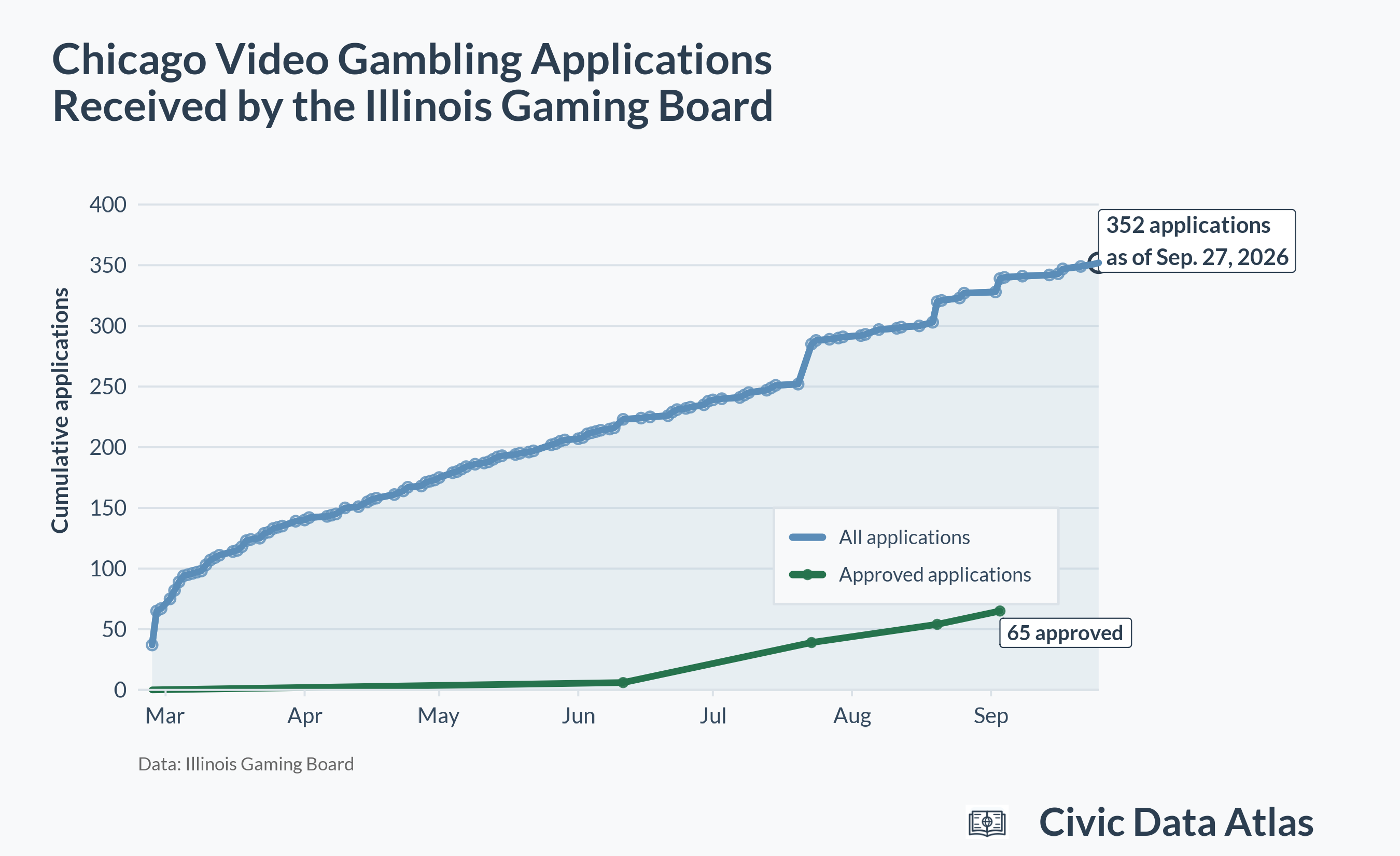
- 352 Chicago establishments have applied for video gambling terminals: 65 are licensed by the state and 287 applications remain pending as of September 27, 2026.
- Using data from Illinois municipalities that have already legalized VGTs, if all current applicants were licensed, Chicago would receive about $7.2 million in annual tax and license revenue.
- However, legalizing VGTs may eliminate Bally’s casino’s $4 million payment to the city and may displace some casino-based gambling that Chicago gets a larger share of tax revenue from. Accounting for these factors, net revenue from VGTs would be roughly $2–3 million.
- Overall, the legalization of VGTs seems much more consequential for individual bars and restaurants than for the city budget. On average, bars and restaurants earn over $100,000 in annual profit from terminals, while even optimistic projections of VGT revenue amount to less than 0.05% of Chicago’s annual budget.
Chicago is locked in a fierce debate about the future of video gambling. Although video gambling was legalized in the 2026 budget, Mayor Johnson fiercely opposed the idea. His administration has yet to license any establishments to allow video gambling terminals, and it’s likely to be debated in the 2027 budget.
If the city continues to allow video gambling and establishes a licensing path, how many establishments will host terminals, and what are the revenue implications for the city?
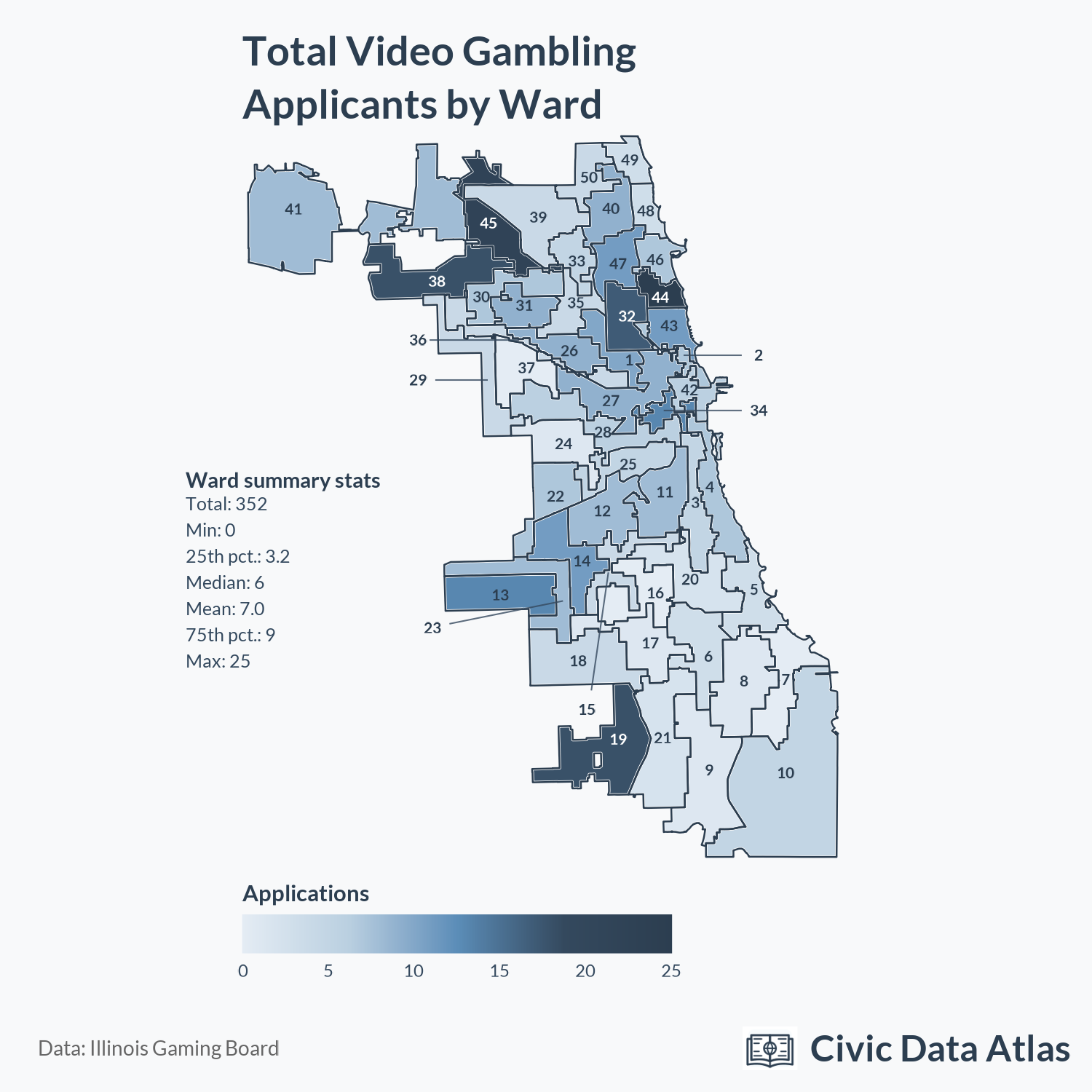
The latest data from the Illinois Gaming Board show that 352 Chicago establishments have applied for a state license to host video gaming terminals (VGTs). Of these, 65 have received state licenses. The map and listing of applications by ward appear below.
After an initial surge when applications opened in late February, applications have continued to climb steadily, at roughly 40 per month.
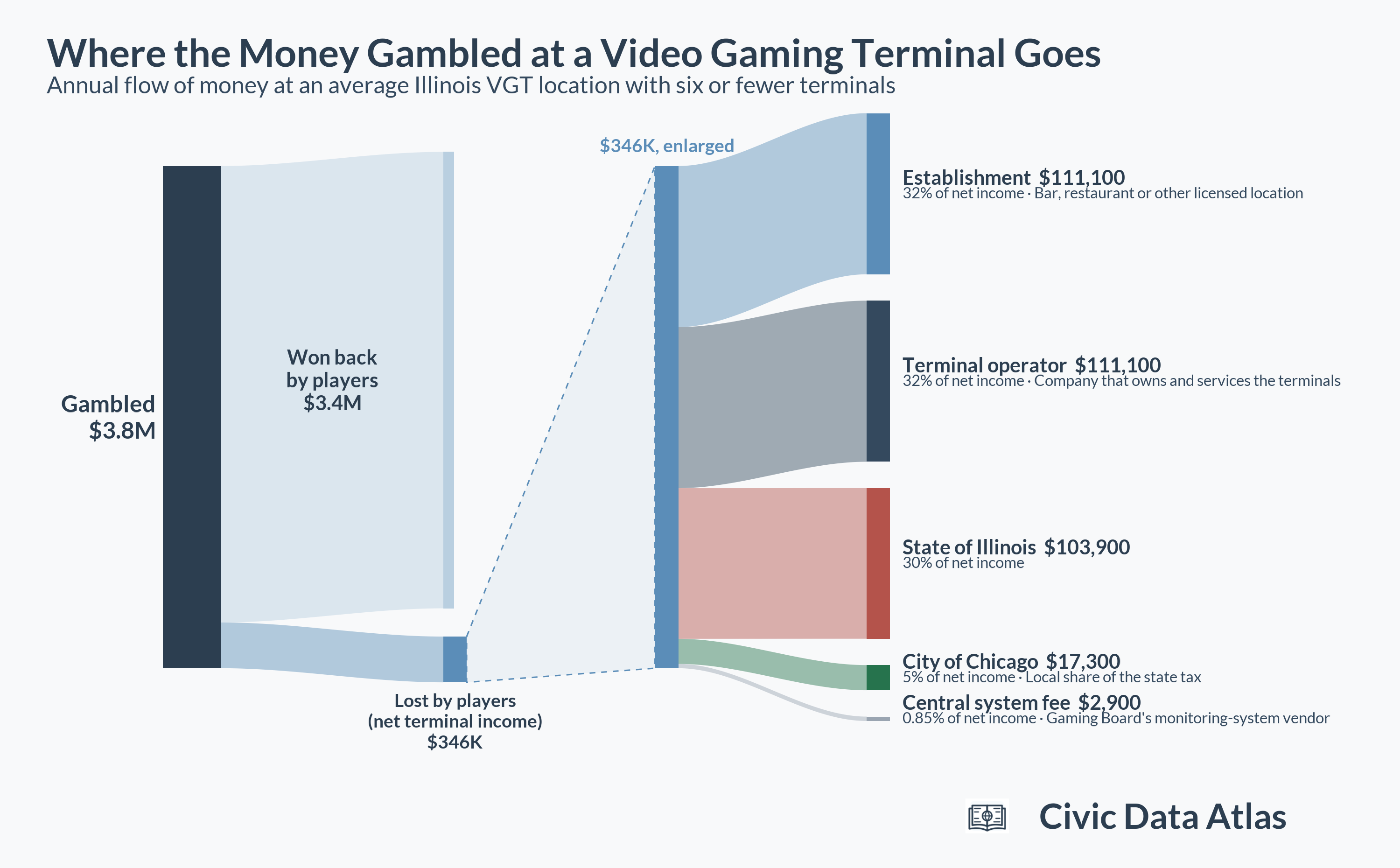
Existing video gambling establishments in areas of Illinois that have legalized the practice can benchmark tax revenue from VGTs for the city. Across comparable establishments in Illinois with VGTs, the average amount gambled in the last year of reported data was $3.8 million and the average amount won was $3.4 million, leaving an average pre-expense, pre-tax profit of $346,000.1 Of the $346,000 average net income, Chicago receives 5%, or approximately $17,300 per establishment per year. If all 352 current applicants were approved and operated for a full year, they would yield Chicago approximately 352 × $17,300 = $6.1 million in municipal tax revenue based on 352 × $3,800,000 = $1.34 billion of gambling (and $122 million in losses).
After taxes and the terminal operator’s share of income (set by law), the average establishment would net roughly $111,000 before its own expenses for operating the terminals.
Chicago would also benefit from license revenue. If all current applicants were licensed by the city and had the same number of terminals as establishments elsewhere in the state, Chicago would net about $1 million a year in license fees.2 Notably, the 2026 budget assumed $6.8 million in VGT license-fee revenue, based on 80% of the city’s 3,300 eligible businesses, about 2,640, applying for licenses. So far, 352 have applied, about one-seventh of that projection.
Impacts on Other Chicago Revenue Sources
Looking at revenue directly linked to VGTs can overestimate the terminals’ total fiscal benefit if they simply draw money away from other forms of consumption that would yield Chicago tax revenue. Much of this debate has focused on VGTs drawing money away from Chicago’s Bally’s casino. If VGT players bet money at terminals that they otherwise would have bet at Bally’s, the VGT tax revenue isn’t so much a fiscal windfall as it is simply tax revenue moving from one bucket (casino taxes) to another (VGT taxes).
In fact, any substitution between video gambling and Bally’s casino is worse than simple revenue reclassification. While Chicago receives 5% of net income from video terminals, it receives roughly 12% from Bally’s operations.3 In other words, for every dollar lost by a gambler at a video terminal, Chicago gets 5 cents, while every dollar lost at Bally’s yields Chicago about 12 cents.
In addition, legalizing VGTs could mean that Bally’s stops making its annual $4 million payment as part of its agreement with the city in exchange for operating a casino.4
The graph below shows net Chicago revenue accounting for all these factors. As it is difficult to predict exactly how much video gambling would take away from Bally’s, the graph shows a range of scenarios. With no substitution from Bally’s to VGTs, VGTs would net $3.2 million after accounting for the loss of the $4 million payment. Under low levels of diversion, revenue stays between $2 million and $3 million, but if a substantial amount of money spent on VGTs otherwise would have been spent at the casino, net Chicago tax revenue could go to zero (at 22% diversion) or even negative.
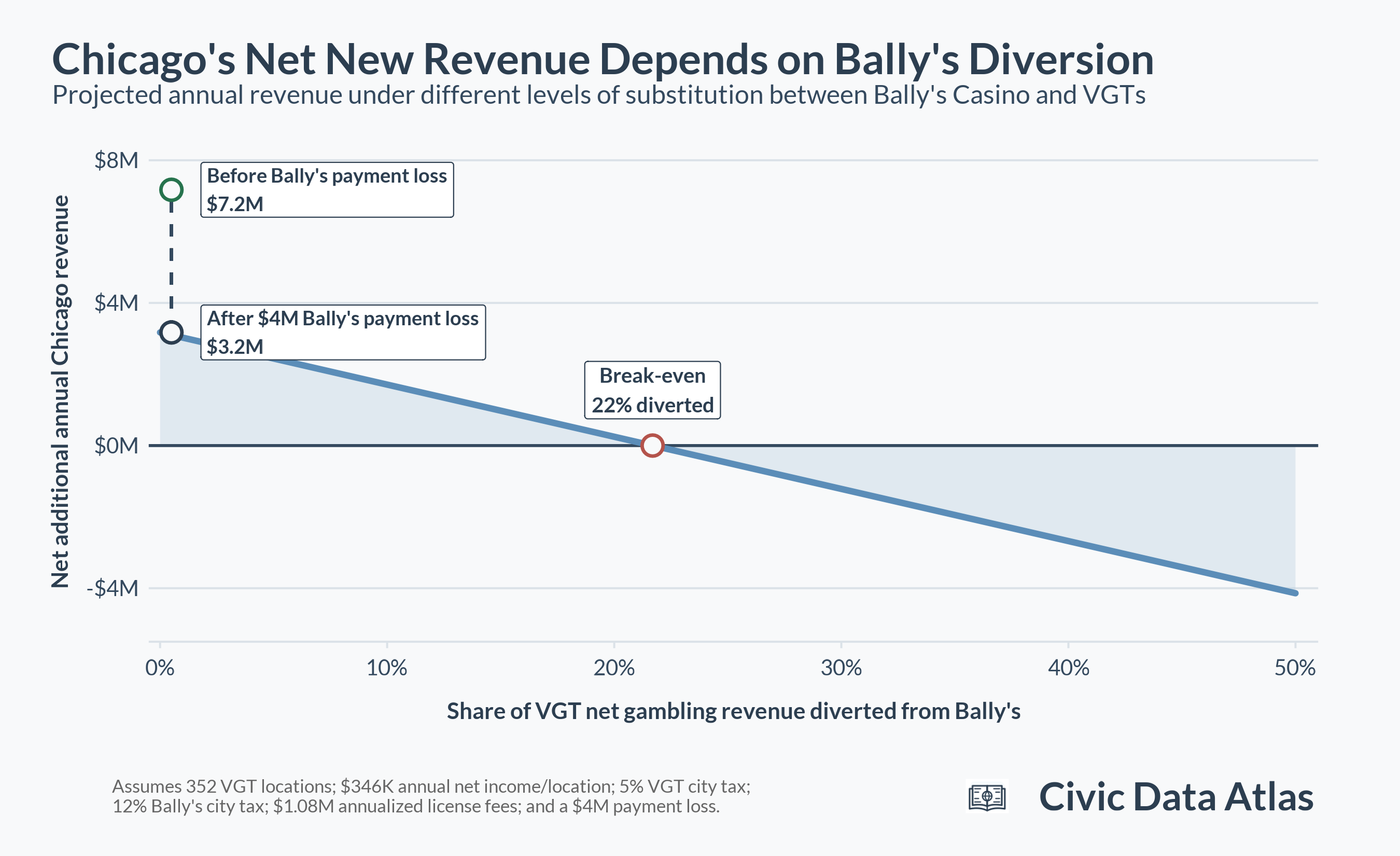
It seems unlikely that VGTs divert so much from Bally’s that they are a net negative for Chicago tax revenue. Academic research has found the diversion to be about 5 cents of casino revenue for every dollar of VGT revenue, which would put net Chicago revenue at about $2.4 million. However, even assuming no substitution, $3.2 million represents less than 0.02% of Chicago’s $16.6 billion budget.5 While framed as a city budget issue, VGT legalization is likely far more consequential for Chicago bars and restaurants that would like to install terminals than for the city’s fiscal health. Based on terminals in other places in Illinois, establishments stand to net over $100,000 in profits annually from installing terminals.
Footnotes
Chicago’s municipal code limits a licensed location to six terminals, so this analysis uses the 9,119 Illinois establishments in the report with six or fewer terminals.↩︎
Under the city’s current fee schedule, a location license costs $500 plus $1,000 per video gaming terminal, and fees are generally assessed every two years. Existing establishments with six or fewer terminals average 5.626 terminals, so the calculation is 352 × ($500 + 5.626 × $1,000) = $2.16 million per two-year fee cycle, or approximately $1.08 million annualized.↩︎
For the first $25 million in net revenue from table games, Chicago gets 6.9%, with higher percentages for larger amounts of revenue. For the first $25 million in net revenue from electronic games, Chicago gets 10.5%, with similarly higher percentages for larger amounts of revenue. Given Bally’s 2025 revenue, we estimate average tax rates were about 12%. They would be higher if the permanent casino has more revenue.↩︎
Bally’s is also halting construction on part of its casino project, citing VGT legalization, though this move may instead be due to Bally’s poor fiscal health.↩︎
Furthermore, while VGTs may not draw much money away from casino revenue, another study found that Illinois municipalities that legalized VGTs did not net any additional tax revenue because VGTs displaced other sales tax revenue.↩︎