Is The Obama Presidential Center Causing Displacement?
A closer look at short-term rentals, rents, and demographic change near Jackson Park
Summary
- Short-term rentals have increased near the OPC, but they still represent less than 1% of renter-occupied households in Ward 20.
- Rents have risen around the center, though the increases are much smaller than home-price gains and look similar to rent growth in other South Side neighborhoods.
- The Black population has declined in Woodlawn, but the share of Black households has held steady or increased, suggesting smaller household sizes rather than widespread household displacement.
Ever since the Obama Presidential Center (OPC) selected its Jackson Park location, many local residents, activists, and policymakers have worried that the project could push nearby residents out of the surrounding neighborhoods. Now, as the center opens to the public, several recent articles have pointed to data suggesting that those concerns are already being borne out.
The case that the OPC is causing displacement rests on three pieces of evidence. First, there has been a spike in homes listed on platforms like Airbnb. Second, there has been a spike in home values. Third, there has been a significant decrease in the Black population. While each of these claims is factually true, a closer look suggests that they do not, on their own, show widespread OPC-driven displacement.
Are Short-Term Rentals Displacing Rental Housing?
The Chicago Sun-Times reported that there has been a 46% increase in “shared housing registrations” (a prerequisite for listing on services like Airbnb) in Ward 20 since 2019. Ward 20 encompasses much of Woodlawn, the neighborhood west of the OPC often seen as most at risk for displacement. Listing homes for short term stays is usually a substitute for renting them out to long term tenants. That depletes the rental housing stock and can drive up rents.
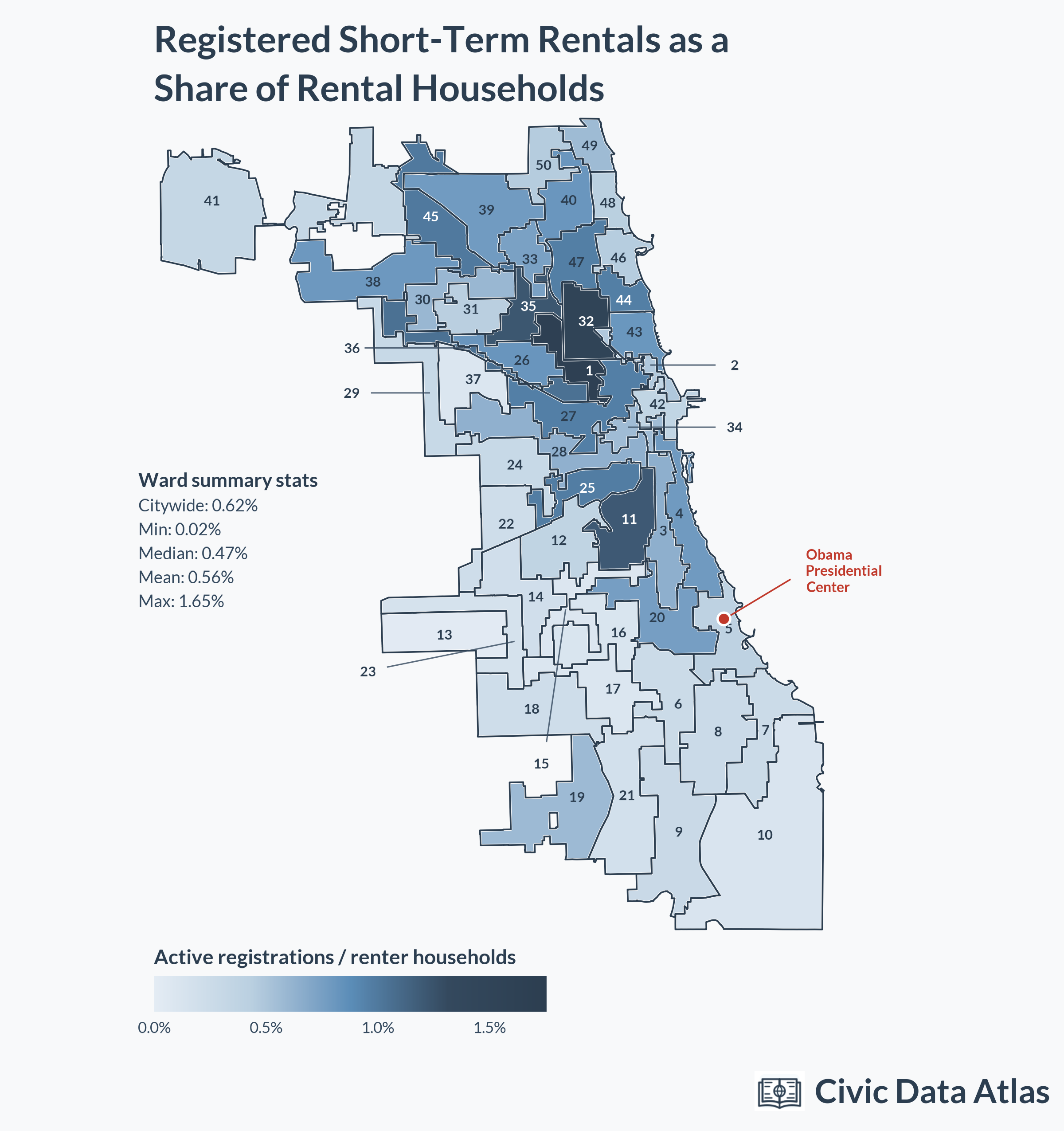
While a 46% increase sounds alarming, the Sun-Times report does not say how many additional registrations that increase represents. According to city data, there are just 122 registrations in the 20th Ward; a 46% increase since 2019 would represent an increase of 38 units. Overall, there are over 16,000 renter occupied households in the 20th Ward; the 122 shared housing registrations represent less than 1% of that total.
The 122 registrations are not abnormally high compared with other Chicago wards: the map below shows shared housing registrations as a share of total occupied rental units in Chicago. Notably, Ward 5, also unmentioned in the article but directly bordering the center, has an even smaller fraction of rental housing stock being used as shared housing.
Finally, the same Sun-Times report cites research estimating that a 1% increase in Airbnb listings leads to a 0.018% increase in rents. If we apply that calculation to the Ward 20 increase, it implies that the 46% increase in Airbnb listings over the last six years would cause a 0.83% increase in rent. At current rents in the 20th, that would be an $8.40 increase per month.
The Sun-Times makes a strong case that the OPC has increased demand for short-term rentals nearby. But those rentals still appear to be a tiny share of the overall housing market. The increases would have to be much larger to have a major impact on any potential displacement.
Are Rents Rising Near the Obama Presidential Center?
The Illinois Answers Project cited data from DePaul’s Institute for Housing Studies that home prices on the east side of Woodlawn, closer to the Obama Center, have doubled since 2019.
Rising property values can contribute to displacement by increasing property tax assessments, which may become unaffordable for some homeowners. However, the people most at risk of displacement are incumbent renters. In Ward 20, more than three-quarters of households rent their homes, and the Illinois Answers Project’s report does not include any data on renters.1
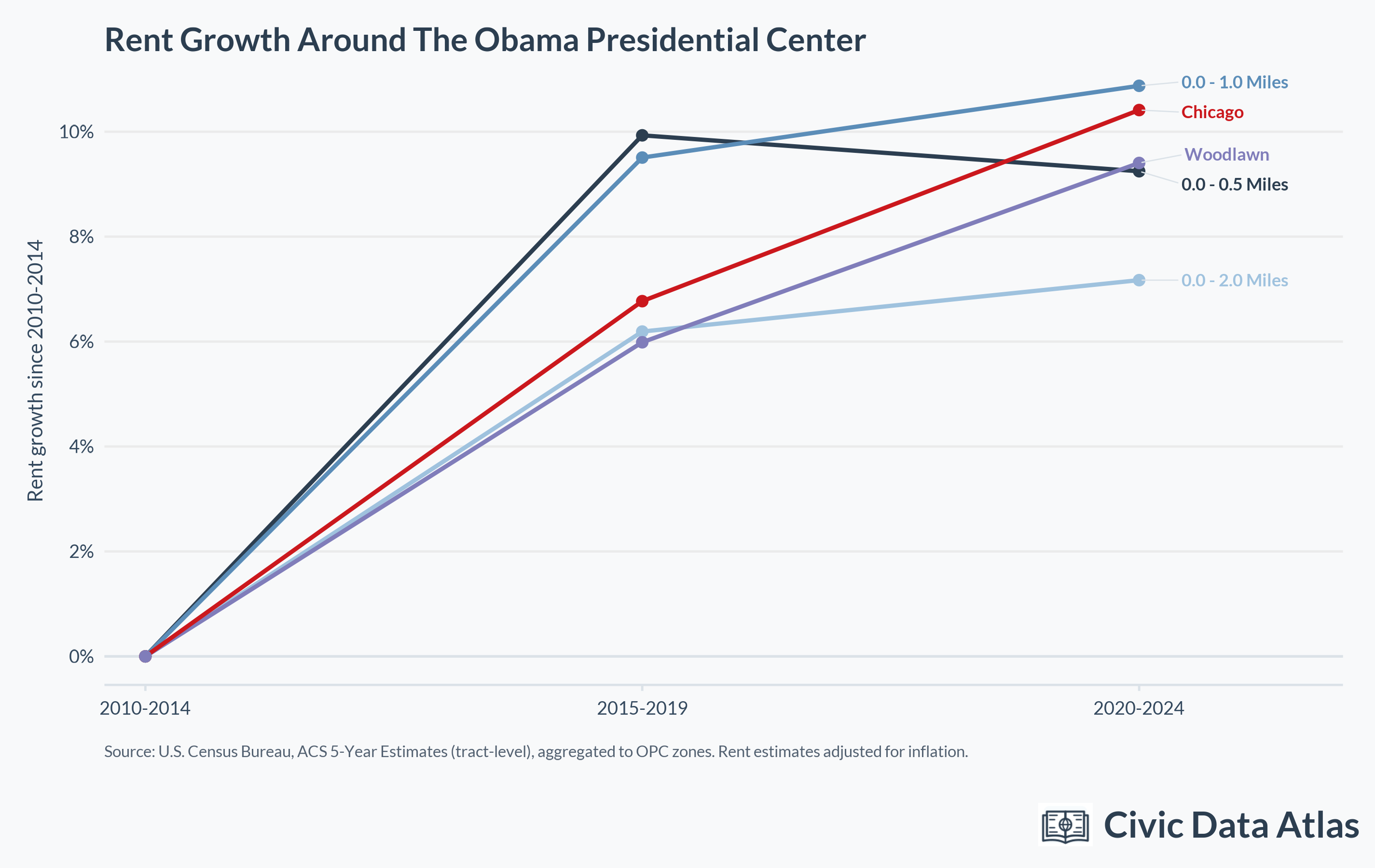
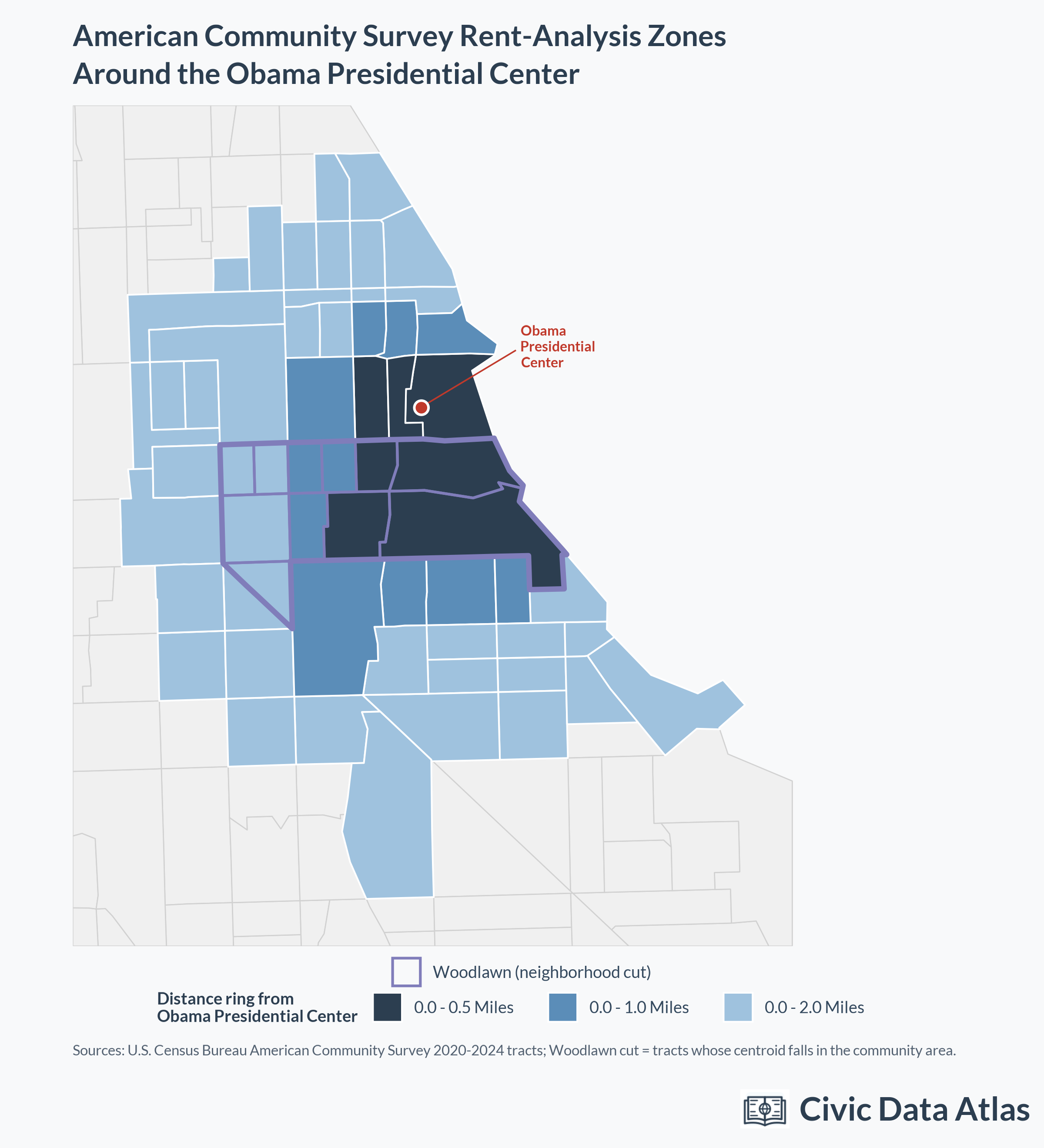
We can use American Community Survey data to compare rents around the Obama Presidential Center over three different five-year blocks: 2010-2014, 2015-2019, and 2020-2024.2 For reference, the Obama Presidential Center location was announced in 2016 and opened to the public on June 19, 2026. All rent price charts are already adjusted for inflation, so the increases are on top of inflation. The specific geographies are shown in a map in the appendix.
The data indicate that rents have increased around the center, but not nearly as much as the reported doubling of home prices. Moreover, most of the increase occurred in the 2015–2019 period, while rent growth in the 2020–2024 period was more modest and, in some areas closest to the OPC, even negative. If the OPC were catalyzing investment-driven gentrification, we would expect the opposite pattern: rent growth accelerating as the center moved closer to opening. Finally, the rent increases around the center are broadly in line with rising rents across Chicago.
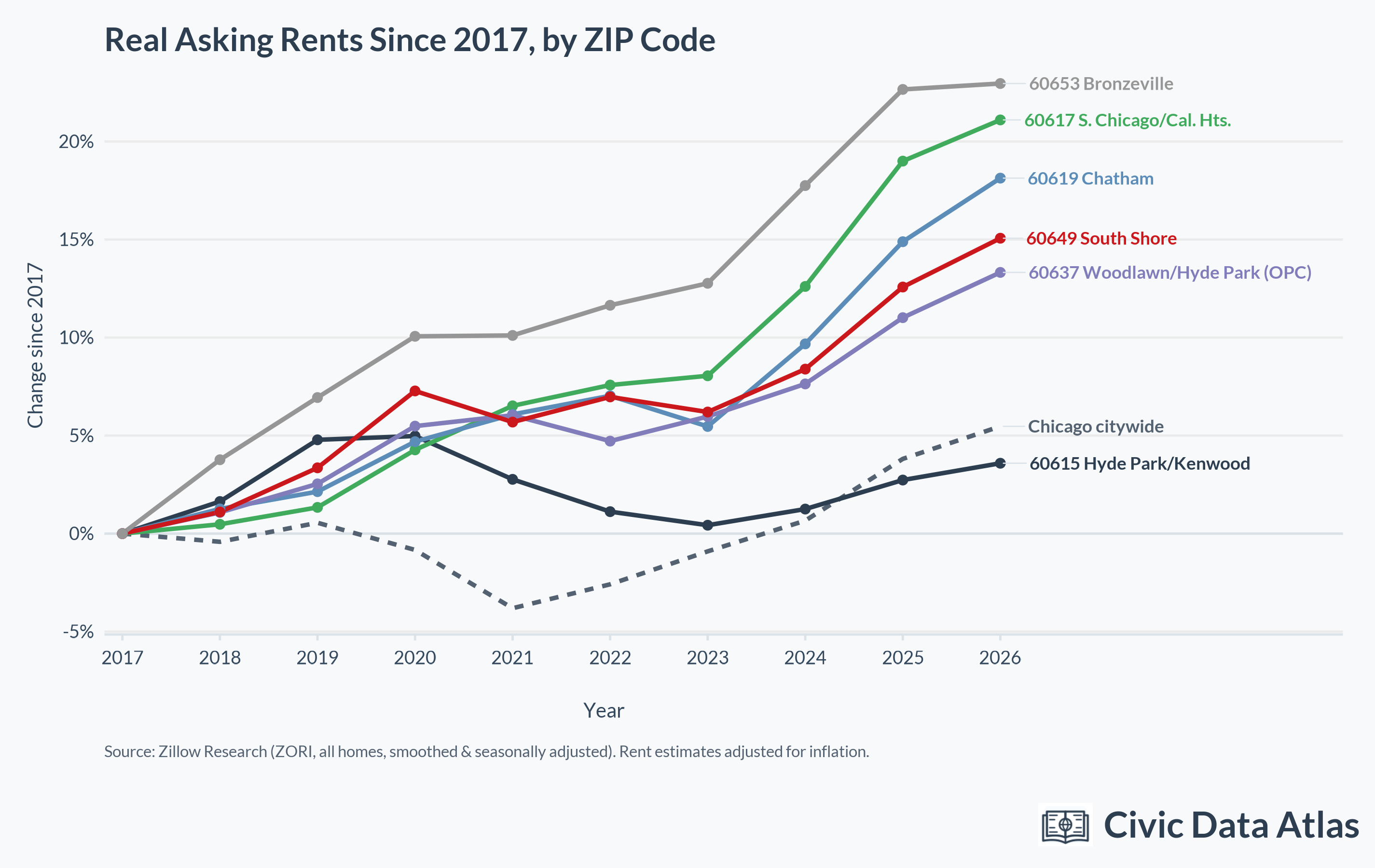
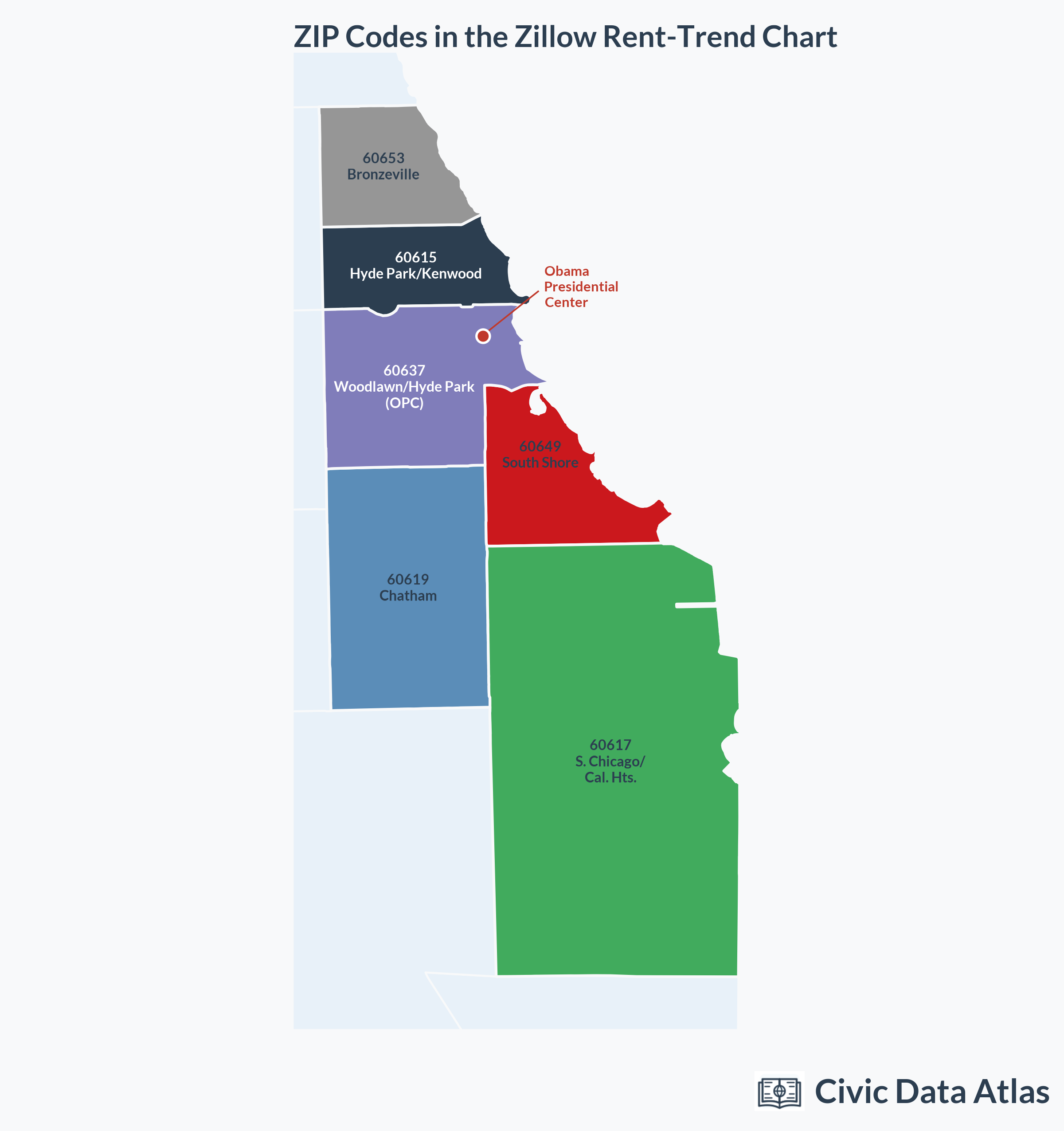
Independent rent data from Zillow shows a broadly consistent story.3 While rents have increased significantly in the Woodlawn neighborhood, other neighborhoods further from the Obama Presidential Center have seen even sharper increases.4
Rent increases consistently above the rate of inflation over a decade could certainly force some people to move. However, similar if not larger rent increases appear in neighborhoods far away from the OPC. This suggests that even if the Obamas had built the center somewhere else, Woodlawn renters would likely still have faced many of the same challenges. If the OPC were the main cause of the rent increases, we would expect those increases to be more concentrated around the center.
Is the Black Population Declining in Woodlawn?
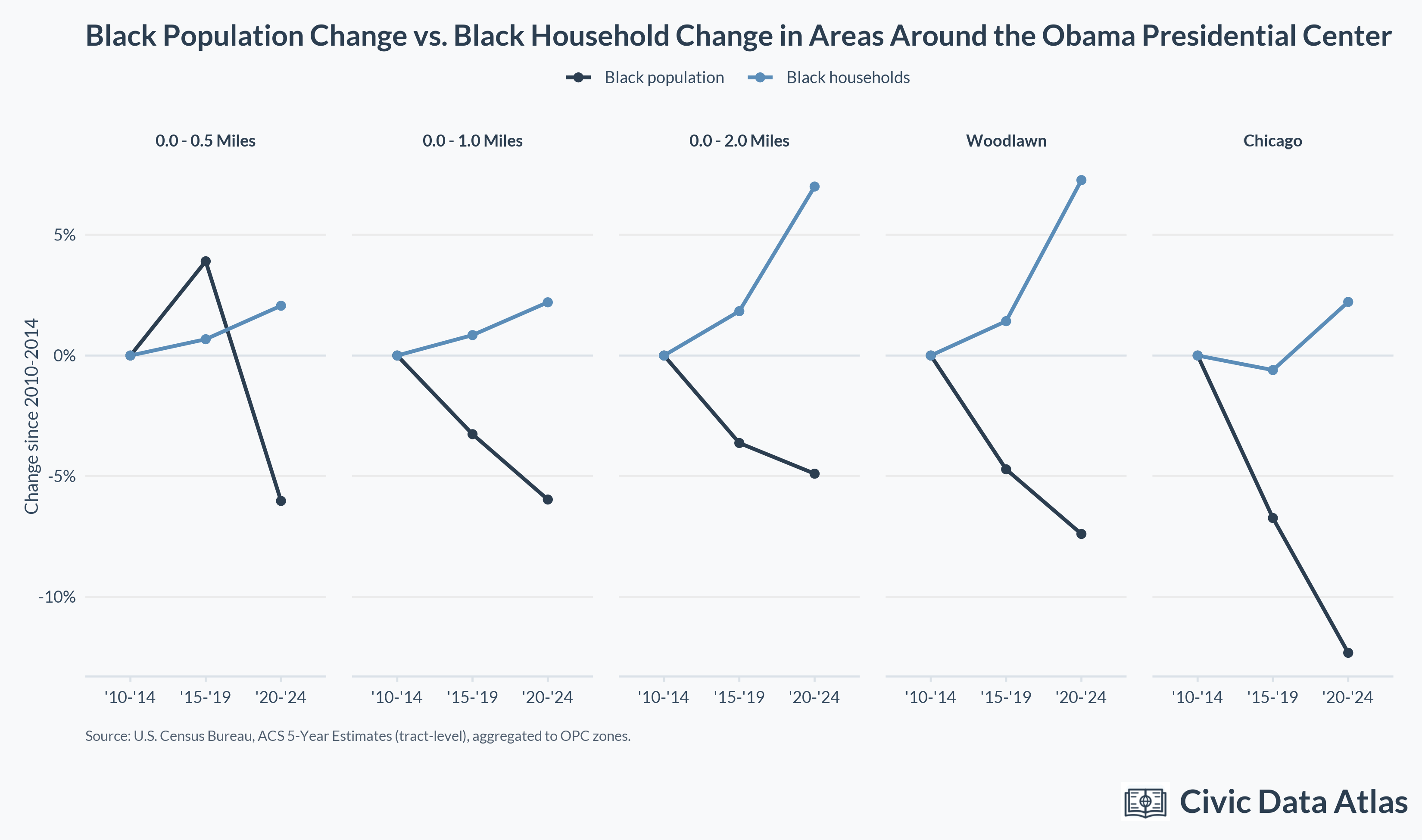
The strongest evidence for displacement comes from the same Illinois Answers report, which used U.S. Census data to show that the Black population declined by 10% between 2015 and 2024. One complication with this analysis is that there have been a lot of shifts in household composition around the same time period. Between 2015 and 2020, Chicago’s population declined, but the number of total households increased.. In other words, individuals who previously shared housing were moving out and forming separate households—a trend that accelerated nationwide after the pandemic.
While a decline in the share of Black households paralleling the decline in the Black population would provide strong evidence of displacement, that is not what the household data show. Instead, the share of Black households has held steady or increased, even as the Black population has declined. That points to a different story: Black households in Woodlawn appear to have gotten smaller. In practical terms, that could mean fewer children living at home, more single-person households, or other changes in household composition. Those changes can reshape the neighborhood, but they are not the same thing as Black households being pushed out of their homes.
Conclusion
The available evidence does not show widespread OPC-driven displacement in the surrounding area. Short-term rental registrations have spiked, but they remain a tiny share of the local rental market. Property values have risen sharply, but rents have grown much more modestly, and similar or larger rent increases appear in neighborhoods farther from the OPC. And while the black population has declined around the OPC, that seems to largely be attributable to declining household sizes: the fraction of black households has actually risen around the OPC since its location was announced.
Just because significant displacement hasn’t happened yet doesn’t mean it couldn’t happen in the future. The OPC is only just now opening to the public. If the influx of visitors further catalyzes investment in the area, rent increases could follow. The Illinois Answers Projects reporting showed that a variety of city-programs to spur affordable housing development and stop displacement in Woodlawn have had little to no impact.
This analysis also does not mean housing affordability is not a serious problem in Woodlawn or the surrounding neighborhoods. Rents near the OPC have outpaced inflation, and for residents whose incomes have not kept up—or who live on fixed incomes—even modest increases can force difficult choices. However, the rent increases visible in the data are not unique to the area around the OPC. Affordability problems and above-inflation rent increases affect large swaths of the South Side, and cannot be attributed solely to the OPC.
Appendix
Footnotes
Rising home prices also make it more difficult for Woodlawn renters to buy a home in their neighborhood.↩︎
As with Civic Data Atlas’s ward level data, the ACS sample is not large enough to provide data for small geographies around the OPC annually, and 2024 is the latest available data.↩︎
Zillow data has its pros and cons relative to the ACS. Its major drawback is its only available at the zip code level, so we can’t precisely focus on areas around the OPC. Second, it only accesses data on listings advertised on its platform, which might not cover the full housing market, particularly in lower-rent areas. Additionally, rents actually paid can differ from advertised prices. However, it is available through May 2026 and at a monthly frequency, while the ACS can only be used in 5-year buckets when zeroing in on small geographies.↩︎
In the Zillow data, Woodlawn-area rents have increased more than rents citywide. However, the timescale and geographic area covered prevent a clean comparison to the ACS data.↩︎