What Wards Would Be Most Impacted By Increasing Chicago’s Garbage Fee?
Background
During last year’s budget negotiations, one floated way of raising revenue was to increase the fee Chicago charges for garbage disposal. For buildings with 1-4 units, Chicago provides garbage disposal services, and charges households $9.50 per month.1 This charge is well under what it costs for the city to provide this service, which has led to numerous calls to increase the fee.
What Wards Would Be Most Affected?
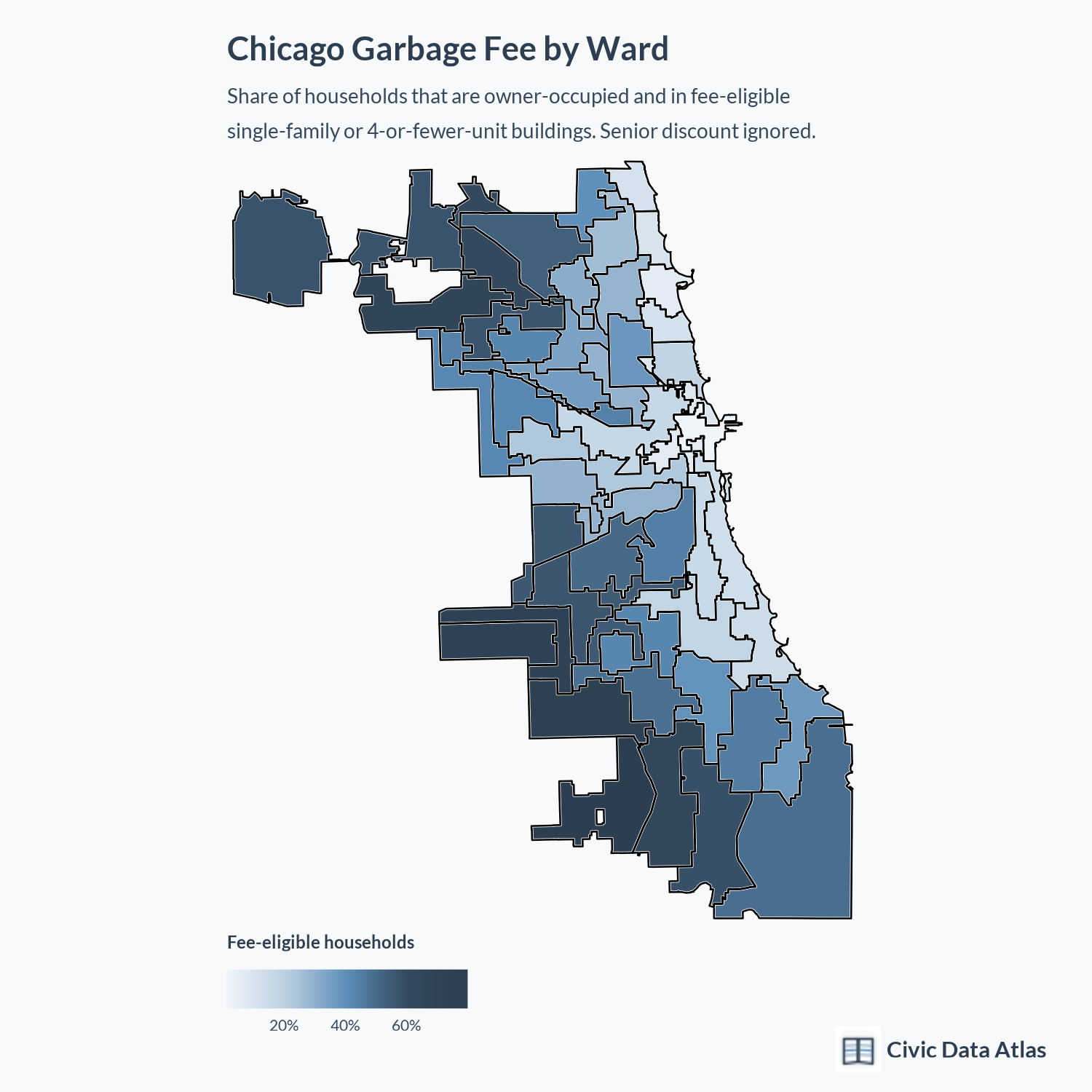
Civic Data Atlas’ ward-level demographic statistics can be used to calculate the fraction of households subject to a fee increase in each ward. The map below shows the fraction of households living in a building with 1-4 units that would be subject to any fee increase.
While a fee increase would apply to all buildings of 1-4 units, renters generally do not directly pay the garbage fee. While landlords could increase rents to cover an increased fee, the map below shows the fraction of owner-occupied households that would directly be exposed.
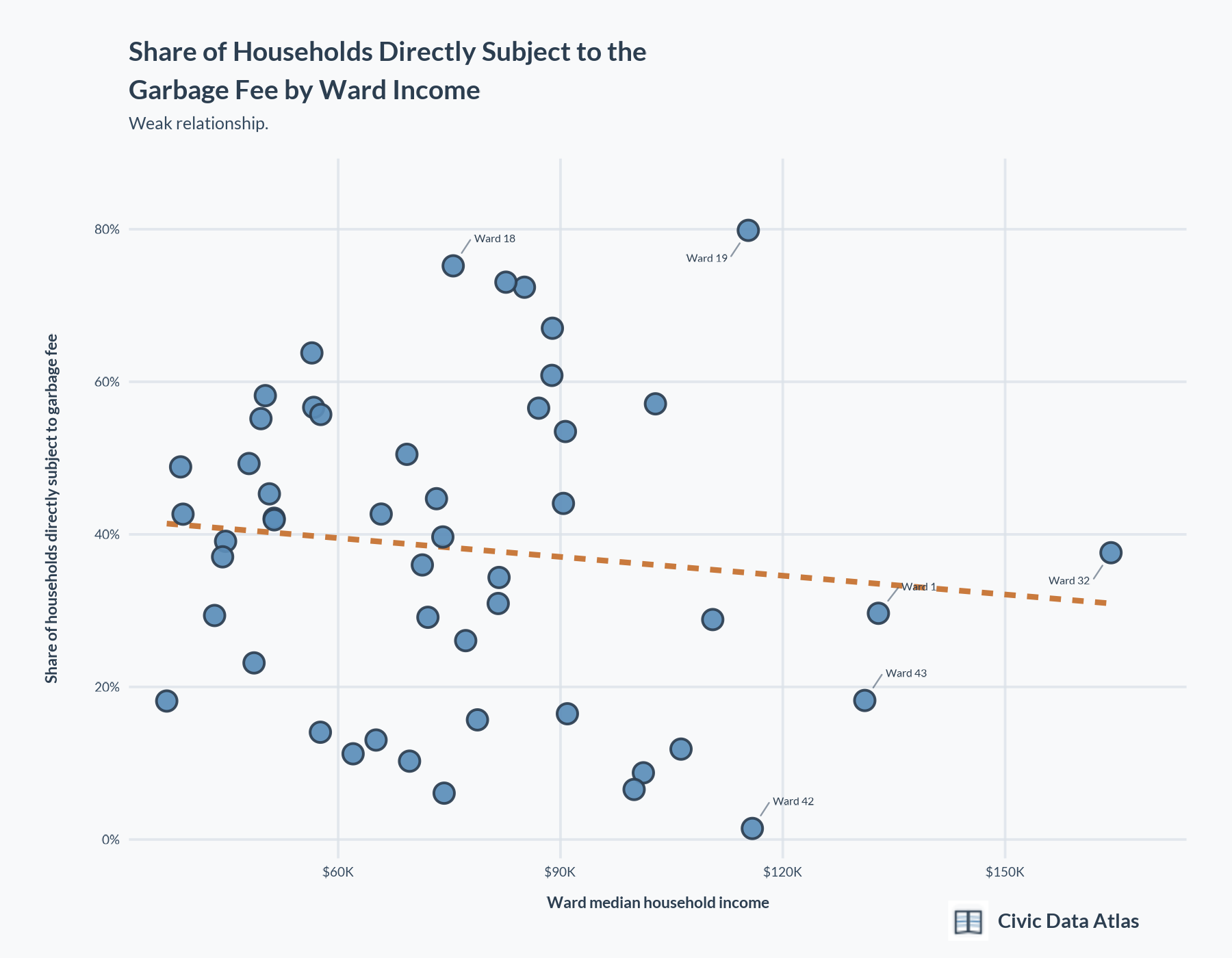
Are Lower-Income Wards Disproportionately Impacted?
Geographic incidence isn’t the same as individual incidence — an increase in the garbage fee could increase fees in higher income wards, but lower income households within those wards. Furthermore, even if the increase isn’t disproportionately felt by lower-income wards, a flat fee has a bigger bite for lower-income households, as it represents a larger share of their total income.
These concerns aside, it’s important to look at the relationship between ward-level income and how many households would pay an increased garbage fee. Alders representing lower-income wards are more likely to stand up for the interests of the lower-income households subject to the fee for whom it is most burdensome
Alternative Budget Coalition and the Garbage Fee
In the 2025 budget negotiations, an increase in the garbage fee was initially part of the package of changes supported by the group of Alderpeople that ultimately provided the votes to pass the 2025 budget. During negociations, the increase was scrapped and it wasn’t included in the final passed budget. But as Chicago continues to face fiscal headwinds, it may come up again.
The 2025 Budget Vote
The 2025 budget passed the Chicago City Council by a vote of 30–17. We can use ward-level garbage fee exposure to examine whether the wards of alders who voted yes vs. no differ in how many households would be affected by a future fee increase.
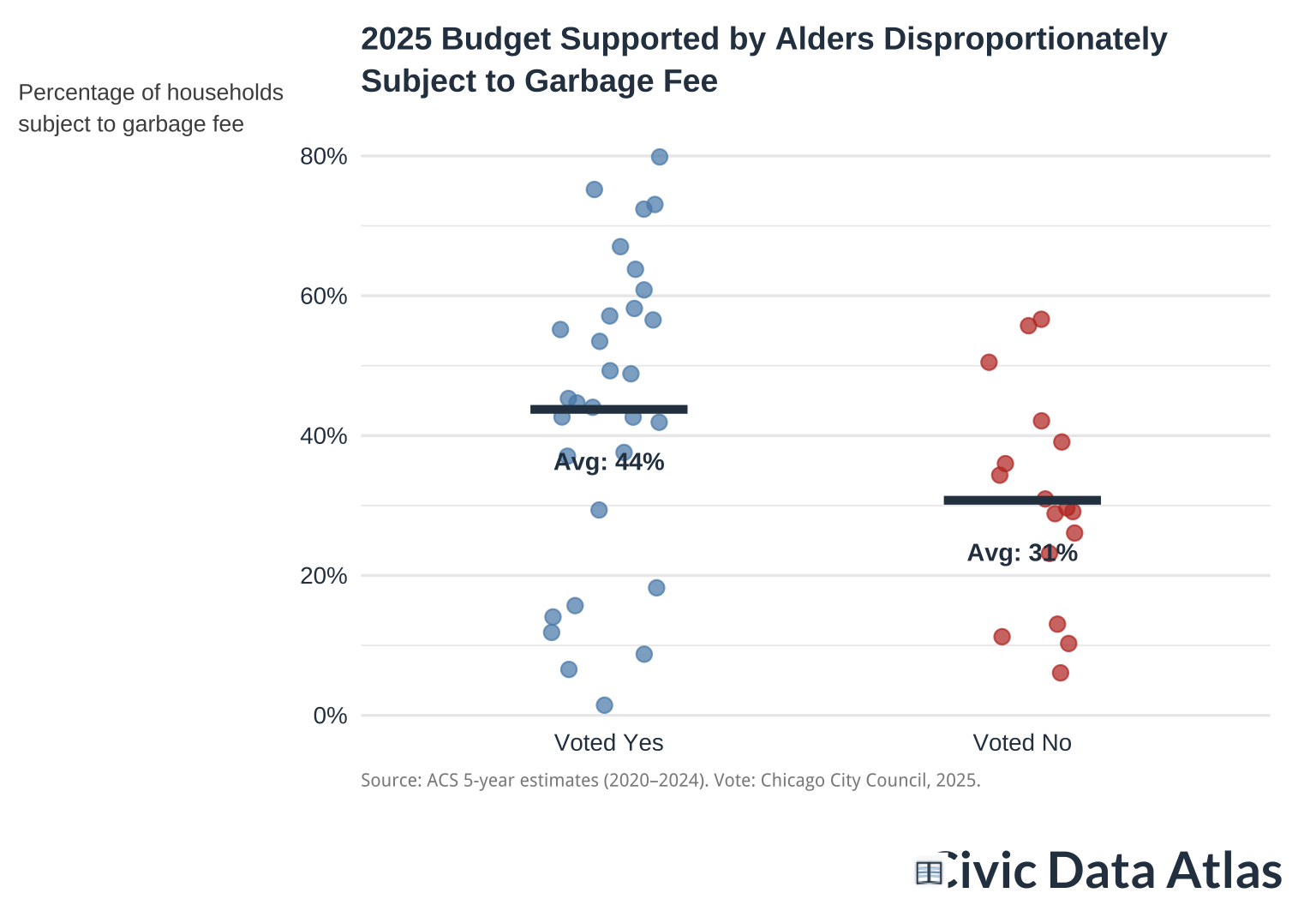
Among the 30 alders who voted yes, the average ward has 44% of households that are owner-occupied in 1–4 unit buildings — and would directly pay any garbage fee increase. For the 17 alders who voted no, the average is 31%. The yes coalition skews toward the bungalow-belt wards of the Northwest and Southwest sides, where small single-family homes dominate. The no coalition is more concentrated in wards with large apartment buildings — both high-rise downtown wards and dense progressive wards on the North Side — as well as several South and West Side wards where fewer households own their unit.
In other words, the political fault line on the 2025 budget does not neatly track garbage-fee exposure. Alders representing the wards most affected by a potential fee increase were, on balance, more likely to vote for the budget that keeps fiscal options open.
Notes
Footnotes
Buildings with more than 4 units must pay for private garbage disposal, and senior owner-occupants subject to the fee get a 50% discount.↩︎